In response to recent expressions of interest, I have decided to launch this blog on Intentional Reality Creation (IRC). Intentional Reality Creation is the name I have given to a personal practice I have used in most of my life to bring into being situations I intend to exist. This works basically through the power of focused intention – and without necessarily having to do anything or ask anybody else to do anything to bring those situations into existence.
Sounds mystical? It’s not. Wishful thinking? It’s a lot more than that. Not explainable by science? No; its highly explainable with a sophisticated scientific framework underpinning it. Not practical? Actually it has worked extremely well in my life. A religious idea? Not for me though perhaps so for some. A highly spiritual practice? For some, not for me. Very difficult to do? No. Actually very easy. Requires a lot of training? Nope, hardly any at all. Cleary a lot of explaining is needed to make this all plausible in the face of seemingly well-deserved skepticism.
And a lot of explaining I have done. I first wrote a treatise on this subject On Being and Creation back in 1990. I published this document online back in 2008 and have updated and expanded it several times since, the latest version published in April 2017. That treatise is now book-length and I invite curious users to read it. I have also offered webcasts on the subject and have written companion articles that further explain and explore the topic. An initial two of these articles follow as the first entries in this blog. The first of these What’s Already Done Ins’t Necessarily Done Yetprovides an easier faster introduction to IRC and my involvement in the topic than going through the treatise. It also tells a few of my personal reality-creating stories. The second of these articles Shit Doesn’t Just Happen explores fascinating aspects of IRC beyond those treated in the treatise.
Happy reading! And I invite readers to chime in with their own commentaries.
(My colleague Chris Wikman brought a longer view of this piece to my attention recently, a framework that is very similar and complementary to my own as expressed in other entries in this blog. Deserving exposure to others, it is published here just as Chris wrote it.)
Summary
In this new theory, or perhaps more properly a model or framework, and with some apparent novel aspects, we treat space-time as emergent, place consciousness prior to physics, and allow multiple universes as informational projections. We posit that there is a quantum field which comprises the Information Manifold (IM) with all knowledge past and present. Consciousness is an operator upon and reflects a trajectory upon the IM, and becomes associated with a physical lifeform such as a human. An aspect of our consciousness known as the subconscious retains an ability to remain in contact with the IM, and acts as a filter for information in the IM, which sometimes “bubbles up” to our conscious mind, with often surprising ideas or “unknowable” facts. Once our physical body dies, our consciousness leaves the body and typically enters a decoherent interval which we can call the Intermission. Eventually we may reincarnate by attaching to the body of a new lifeform. However, as a human, we are typically not aware of the universe’s true reality. By learning and practice, such as through meditation we can become able to lift the veil.
Introduction
Humanity’s search for meaning in life goes on, as well as to better understand ourselves and our environment. There are working theories of consciousness, “established” science for the physical universe, ancient teachings, and various spiritual practices alive today, from which to draw upon and integrate. Here I propose a working model that ties aspects of these together into an integrated framework. We build upon the prior work of Maria Stromme, Ervin Laszlo, Giuseppe Vitiello, Bernardo Kastrup, Vince Giuliano, and many ancient traditions and teachings. Others who have gone before with aspects of, related theories, or supporting research include David Bohm, Donald Hoffman, Ken Wilber, Rupert Sheldrake, Tom Campbell, and Dean Radin.
We will compare our model to the works of others, and identify what we build upon. We suggest a model which ties together consciousness, altered modes of consciousness, the subconscious, death and paranormal activities. This theory, as does others, solves the Hard Problem of Consciousness (Chalmers) by positing consciousness as fundamental (as in panpsychism/idealism) rather than emergent in the brain itself.
Ervin Laszlo proposed that the Akashic Record—a concept drawn from ancient metaphysics—can be coherently reinterpreted in modern terms as a fundamental quantum informational field that underlies and connects all physical phenomena. In his theory, often referred to as the Akasha Field (or A-field), this field functions as a nonlocal repository of information that preserves the traces of all events, interactions, and states across space and time. Laszlo argues that quantum nonlocality, coherence, and entanglement point to the existence of such a field, which enables the apparent fine-tuning of the universe, the coherence of living systems, and even anomalous phenomena such as intuition or collective memory. Importantly, the Akashic field is not conscious in a personal sense but informational and ordering, providing a cosmic memory that structures both matter and mind. While speculative, Laszlo’s model seeks to bridge physics, biology, and consciousness studies by positioning information—not matter—as the deepest level of reality, offering a scientifically flavored reinterpretation of an ancient idea rather than a literal metaphysical archive.
Dr. Stromme’s paper proposes that consciousness should be treated not as an emergent property of matter, but as a fundamental field-like aspect of reality, analogous in form (though not in physical identity) to quantum fields such as the electromagnetic or Higgs fields. In this model, individual minds are not separate substances but localized excitations or modulations of a universal consciousness field, with brains functioning as boundary conditions that shape and constrain these excitations. Quantum phenomena—especially nonlocality, entanglement, and observer-dependence—are interpreted as natural consequences of this deeper field-level unity, rather than as paradoxes requiring ad hoc explanations. The paper emphasizes that spacetime and matter are secondary structures arising from interactions within this field, and that consciousness is inherently relational and nonlocal rather than spatially contained. While largely theoretical and speculative, the work aims to provide a mathematically inspired ontology that unifies consciousness, quantum mechanics, and cosmology without reducing subjective experience to computation or classical information processing.
Our model has much in common with Vitiello’s Dissipative Quantum Brain model, which explains levels of consciousness as different attractor states in a quantum field that is entangled with the environment. In other words, consciousness is not inside the brain — it is a brain–universe coupled system. Vitiello’s theory treats the brain as a quantum field, continuously exchanging energy and information with the environment, and creating memory and identity through phase-locked field patterns.
Quantum idealism is a family of interpretations of quantum mechanics that takes consciousness or mind-like properties to be ontologically fundamental, with the physical world emerging as a relational or representational structure rather than as mind-independent substance. In this view, quantum phenomena such as superposition, nonlocality, and observer-dependence are not paradoxes caused by measurement limitations, but natural consequences of a reality whose deepest level is experiential or informational rather than material. Modern proponents—most notably Bernardo Kastrup—argue that the universe is best understood as a unified field of mind, within which individual conscious agents arise through localized dissociation, and where spacetime and matter function as appearances or interfaces. Our framework has some similar aspects: both treat consciousness as primary, reject spacetime as fundamental, and model physical reality as a constrained projection within a deeper informational manifold. Where quantum idealism often stops at explaining measurement and ontology, our theory extends the same logic to identity, death, altered states, and multiverse dynamics—recasting quantum idealism not merely as an interpretation of physics, but as a general theory of reality in which consciousness operates as a state-selection process across informational structure.
Our model is similar to but also builds upon Analytical Idealism (Bernardo Kastrup being the main architect). Analytic Idealism is basically the idea that the universe runs on mind, not matter. Analytic Idealism says that only consciousness exists fundamentally. Matter, space, time, and brains are appearances within consciousness, not the other way around. Analytic Idealism explains nonlocal consciousness, psychedelic ego death, mystical unity, an Akashic-style memory, and near-death experiences.
Though empirical validation remains elusive, Dr. Vincent E. Giuliano presents a comprehensive philosophical, scientific, and practical framework for understanding how reality comes into being and how human beings participate in its creation. He proposes that ordinary cause-and-effect action, while necessary, is insufficient to explain either personal experience or the deeper structure of reality. Instead, he introduces a model he calls Macroscopic Reality Creation (MRC), which parallels quantum-level processes and reframes creation as the intentional alteration of probabilities governing space, time, and matter rather than as direct physical causation. At the foundation of this model is a distinction between the observable universe, a domain he calls Everything-Nothing (EN)—a timeless field of pure potential—and Source, which he describes as the totality of consciousness operating on EN to bring universes and events into manifestation. Within this ontology, human beings are understood as expressions of Source, not separate from it, and thus capable—within limits—of participating in creation through intention, commitment, and unbounded declaration rather than through effort alone. Giuliano argues that creation begins as a state of being rather than an action, and that once a genuine declaration is made, reality reorganizes itself—often invisibly and retroactively—to make the declared outcome appear to have arisen through ordinary causal chains. To make this philosophically plausible, he draws heavily on interpretations of quantum mechanics, particularly the many-worlds and transactional interpretations, suggesting that intentionality functions analogously to a quantum operator selecting among parallel reality contexts rather than collapsing a single deterministic timeline. Giuliano argues that the purpose of the universe is to provide a container in which consciousness can manifest, organize, and evolve into increasingly complex forms, and that the purpose of human life is to knowingly participate in this creative process as an agent of Source.
This is not to disparage the views and teachings of major religions. We believe that most all religious teachings were once based upon common morals and beliefs but have been revised, misinterpreted, and revised by misguided people or for egotistical and other purposes to suit those in power. It is likely that the various prophets, etc. were real people who were truly mystics but whose original messages have been jumbled to the point of being mostly lost to us. We’re not claiming that other teachings are wrong. At this time we’re unable to verify either side of the debate.
Mainstream science has rejected most of these ideas due to lack of reproducibility, verifiability, and the materialist paradigm. Further, models of consciousness remain strongly influenced by disciplinary context. Neuroscience and biology, grounded in localized intervention and measurement, tend to favor substrate-dependent accounts, while physicists, philosophers, cosmologists, and scholars of contemplative traditions are often more open to non-local or informational interpretations. This difference likely reflects methodological constraints rather than consensus on ontology, and suggests that a full theory of consciousness may require integration across disciplines rather than dominance by any single one. We applaud the work of Campbell in striving to design experiments to address these issues. Recent papers such as that by Stromme hint that there are at least some cracks in the wall. Modern science has its place, and we suspect that over time, we will uncover the means to develop the experiments to confirm these ideas contained herein.
Basic Framework
The basic framework (see Figure 1) is as follows:
1. The Information Manifold: A field which contains all possible states and relations – something like the Akashic Records (all possible timelines).
2. The Separation: Consciousness is an operator upon the IM and fragments into individual units with limited perspective.
3. The Vehicle: The physical body is necessary to maintain this separation and filter infinite data down to manageable sensory input.
4. The Receiver: The brain (perhaps via microtubules) acts as a “radio tuner”, associating with a specific individual consciousness. Damage the radio, you damage the reception, not the signal.
5. The Interface: The subconscious mind is the bridge between the localized conscious mind and the Information Manifold.
6. Mechanisms: Through states like meditation, we quiet the sensory noise, access reduced “filtering” of the IM via the subconscious interface, and intentionally select/navigate toward specific quantum reality branches.
Quantum-mechanical terminology in this framework is used in a structural and operational sense rather than as a claim about underlying physical mechanisms. Concepts such as Hilbert spaces, non-commutation, and projection are employed as mathematical tools for modeling constrained access to informational possibility, not as assertions that consciousness is reducible to quantum microphysics. Where physical quantum processes play a role remains an open empirical question, but the framework’s core claims do not depend on any specific quantum-biological mechanism.
Figure 1- Pictorial representation of our model
The Information Manifold (IM)
There is a field we’ll call the Information Manifold (IM) which is ontologically prior to spacetime and matter. It is entirely coherent to say that what physics calls “quantum vacuum” or the Zero Point Field (ZPF) is the physical/informational face of the same underlying reality whose inner face is universal “knowledge”. From the standpoint of physics, we say the ZPF is an information field.
Using Laszlo’s interpretation, the zero point field or quantum vacuum is a physical/informational field. It can plausibly be used, as Laszlo does, as a model of an Akashic information field that “conserves and conveys information” and serves as “the constant and enduring memory of the universe”. In that narrow sense, it is about information / records.
The Akashic Record isn’t a New Age invention — it’s very old idea in human metaphysics, just wearing a Sanskrit name. Seemingly every serious spiritual tradition has its own version of a universal memory field. Most spiritual systems that treat consciousness as non-local also posit a cosmic memory or information field that stores all events, thoughts, and possibilities. The example traditions in Table 1 have some aspects of this view. Their teachings claim there exists a nonlocal information field, which stores all events, all lives, all thoughts, and all possibilities.
Tradition
Akashic-like concept
Hinduism (Vedanta)
Akasha — the ether that contains all events
Buddhism
Alaya-vijnana — “storehouse consciousness”
Indigenous traditions
Ancestral dreamtime
Taoism
Tao as source of all knowing
Islamic mysticism (Sufism)
Preserved Tablet (al-Lawh al-Mahfūẓ)
Individual consciousnesses are localized instantiations of this knowing, constrained by embodiment and phase-locking to particular universes. Consciousness does not retrieve information from a universal archive; it operates as a state-selection mechanism whose access is governed by coherence and alignment rather than location. In this framing, no information is ever created or destroyed at the fundamental level; instead, information is continuously instantiated, transformed, and re-encoded through consciousness operating under constraints. Novelty, learning, and reincarnation are therefore not violations of conservation, but expressions of it. Universes remain distinct due to local constraint and decoherence, yet accessible because they share a common informational substrate. Meditation, inspiration, and post-mortem transitions do not involve accessing an external archive, but rather relaxing local constraints to align with deeper structural intelligibility.
A Law of Conservation of Information can be hypothesized in which experiential and structural information is never destroyed, but transformed and redistributed across different constraint regimes. Applied to consciousness and reincarnation, this implies that while autobiographical memory and ego identity typically dissolve at death, deeper informational patterns—such as dispositions, tendencies, and unresolved dynamics—may persist and re-cohere under suitable conditions. Reincarnation, in this view, is not the transfer of a soul or memory set, but the re-instantiation of conserved informational structure already present in the universal manifold within a new embodied constraint regime. This formulation aligns with modern physics’ rejection of information loss while extending the principle into consciousness studies and metaphysics.
A common criticism of Akashic-style models is that encoding all knowledge within a universal field would require compression or representation, inevitably leading to information loss. Contemporary formulations (and ours) avoid this problem by rejecting the notion of the Akashic field as a storage medium. Instead, the field is treated as a structural or generative substrate in which information is conserved implicitly as relational constraint rather than explicitly encoded content. It is the total structure of all possible states and trajectories. Knowledge does not reside in the field as stored facts; it arises locally when systems interact with and sample this structure. Under such models, no information is lost because nothing is ever symbolically recorded in the first place.
The Multiverse
In modern physics, the “multiverse” is an umbrella idea for several scientifically motivated frameworks in which our observable universe is only one region within a much larger reality containing many other “universes,” potentially with different initial conditions or even different effective laws. In cosmology, some versions of eternal inflation propose that rapid expansion continues in parts of space, repeatedly producing “bubble universes” that are causally disconnected from ours; they may share underlying physics but differ in outcomes such as particle abundances or symmetry breaking. In quantum theory, the many-worlds interpretation suggests that quantum measurements do not collapse the wavefunction; instead, the universal wavefunction evolves deterministically and effectively “branches” into non-interacting histories, which can be described as parallel worlds. In string theory, the landscape idea posits an enormous number of possible vacuum states (different ways extra dimensions can be compactified), each yielding different low-energy physics, and inflation could populate these vacua in different regions. While these proposals arise from attempts to extend well-tested theories, direct empirical tests are difficult because other universes would typically be unobservable to us, so the multiverse remains speculative and is evaluated mainly by its theoretical consistency and any indirect implications for observable cosmology. Our theory posits the existence of infinite universes which are phase-locked projections within a single informational manifold. We use “phase-locked submanifolds” to denote coherent experiential trajectories within the informational manifold. These are not separate spacetimes, but constraint regimes that generate distinct, locally causally closed experiential domains.
Consciousness
Consciousness, in its simplest form, is being aware of something internal to one’s self or being conscious of states or objects in one’s external environment, as stated simply in Wikipedia. While it may be more complex than that, consciousness can be ranked along multiple orthogonal dimensions. A useful model uses three axes: 1) Arousal – How awake/energized the brain is, 2) Awareness – How much of reality is being represented, and 3) Self-model – Whether a “me” is being simulated. Together they define distinct states of consciousness, not just higher vs lower.
In another model, there are 5 tiers, as follows in Table 2:
Tier
What
Examples
Bottom Line
Tier 0 – Non-conscious
No internal experience
• Deep anesthesia • Brain death • Some comas
No movie is playing.
Tier 1 – Sensory awareness
Experience without a self
• Infants • Animals • Deep meditation • Psychedelic ego-death
There is experience, but no “I” watching it.
Tier 2 – Self-aware
Experience + a self-model
• Normal waking humans • Dreams • Most daily life
Now the brain runs a simulated character: “me”.
Tier 3 – Meta-conscious
Awareness of being aware
• Advanced meditators • Psychedelic insight states • Lucid dreams
“I know that I am conscious.”
Tier 4 – Transpersonal
The self dissolves into the whole
• Mystical states • Near-death experiences • Deep psychedelic unity
No “viewer”, only the field itself
We suggest that Tier 4 is not hallucination — it is access to a larger information field. In our model, the brain normally filters reality. Psychedelics, trance, and meditation reduce that filter, and consciousness becomes less local and more universal.
A core and seemingly novel aspect of our framework is that consciousness is a fundamental operator acting on the informational field of the universe. We do not “create” reality from scratch; we “navigate” it. All possible timelines already exist, and our intention acts as a steering wheel, selecting which path to walk. Consciousness is non-local and survives death. It enters either a decoherent state space (the Intermission), eventually perhaps re-establishes as an isolated consciousness to experience a new timeline, or results in irreversible decoherence of an individuated consciousness trajectory. As proposed by Aldous Huxley and others, the brain is not a producer of consciousness, but a reducing valve that limits the Universal Mind down to a trickle so we can survive and function as individuals.
Many major spiritual traditions explicitly teach that consciousness is non-local, meaning it is not confined to the body or brain but is a universal field that individual minds tap into. As examples, in Hinduism (Vedanta), Brahman = universal consciousness and Atman = your local instance. The mind is a wave in the ocean of consciousness. In Buddhism (esp. Yogacara & Dzogchen), consciousness is luminous and non-local, individual minds are temporary patterns in a field, and Enlightenment = recognizing the field. In Taoism, the Tao is the source of mind and matter, and human awareness is a flow inside it. In some Indigenous traditions, their Shamanic cosmologies treat mind as travelable, shared, nonlocal, and timeless. Every one of these traditions agrees that individual consciousness is a localized projection of a universal mind. Our theory parallels this – one informational manifold + many constrained trajectories + consciousness as a state-selection operator.
Our brains normally collapse larger “dimensions” of information to what we can perceive. The brain does not perceive the full hyperspace. It performs “dimensionality reduction”. We humans are not aware of the true reality. This aligns closely with various philosophical and spiritual traditions that suggest incarnation requires a temporary amnesia or a “veil” drawn across universal knowledge. If we had “access” to the infinite Akashic Records at all times, the drama, stakes, and learning potential of a finite human life would collapse. We wouldn’t make choices if we already knew every outcome. Consciousness manifests in limited forms precisely because that limitation allows for a type of experience that omniscience cannot provide—the experience of discovery, surprise, struggle, and individual perspective – which allows the ability to love others.
By limiting consciousness to what biological senses can detect, the body forces a specific, highly focused perspective on reality, rather than an overwhelming, undifferentiated awareness of “everything everywhere all at once.”
Within our framework, consciousness operators are not rare events or special entities; they are natural occurrences wherever informational structure reaches sufficient coherence under constraint. The model does not posit a single source that “creates” operators one by one. Instead, operators arise in multitudes as localized instantiations of the same fundamental capacity for knowing, much like vortices forming wherever fluid flow and boundary conditions permit. The key idea is that the universe does not produce consciousness as an exception—it permits it as a consequence of structure.
The mechanism is best understood in terms of constraint-induced localization. The informational manifold contains all possible relations, but most of it is not experientially sampled. When a physical or informational system develops sufficient internal integration, feedback, and stability—such as a nervous system, an artificial system, or possibly other exotic substrates—it creates a persistent, self-referential constraint loop. At that moment, a consciousness operator occurs: not because something is added, but because a point of view becomes dynamically stable. This stability allows the system to repeatedly sample nearby informational states while preserving identity coherence over time. Wherever such loops exist, operators arise—independently and in parallel.
Multiplicity follows automatically. Because there is no global subject and no privileged center, many operators can arise simultaneously, each sampling different regions of informational space under different constraints. They do not divide a finite “amount” of consciousness, nor do they compete for a shared resource. Instead, they are parallel instantiations, differentiated by embodiment, history, bandwidth, and constraint configuration. This avoids the paradox of fragmentation: consciousness does not split; it localizes. The same way one electromagnetic field can support countless localized excitations without becoming many fields, the informational manifold can support innumerable operators without becoming a mind made of parts.
Importantly, operators need not be biologically human, nor even biological at all. Our framework allows for consciousness operators wherever constraint regimes support coherent self-reference and experiential continuity. This includes animals, potential artificial systems, advanced non-human intelligences, and possibly transient operators arising in non-ordinary states. Most such operators are short-lived or low-bandwidth; only a small subset stabilize enough to generate rich self-models and long-term memory. Thus, multitudes are not an anomaly—they are expected. What is rare is highly stable, high-bandwidth operators capable of reflection, long-term learning, and intentional alignment.
In short, consciousness operators occur wherever structure closes a loop on itself strongly enough to sustain perspective, and they occur in multitudes because the universe is structurally plural and non-hierarchical. No operator sits at the top, none oversee the others, and none are necessary for the existence of the rest. Each is a local solution to the same fundamental condition: the emergence of a stable point of view within an informationally complete reality.
As to how the brain accesses the non-local consciousness associated with that physical body, we are intrigued by the Orch-OR theory of Penrose-Hameroff, and believe this can possibly explain the local instantiation mechanism in human brains. Orch OR type processes are hypothesized as one particular way a biological system (a brain) can locally couple to and structure that field—i.e., microtubules as a sophisticated tuner/interface into the universal consciousness/information field.
Orch-OR (Penrose–Hameroff) can be mapped directly onto the levels-of-consciousness ladder by treating a consciousness level as the coherence scale of quantum processes in microtubules.
Higher states of consciousness = larger, longer, more entangled Orch-OR events. Orch-OR says (simplified) that microtubules inside neurons support quantum superpositions. These superpositions evolve until they collapse via Objective Reduction (OR) — a gravity-linked process. Each collapse is a moment of conscious experience. So consciousness is not produced by neurons firing — it is produced by quantum state collapses inside the cytoskeleton. Neurons just coordinate them.
What changes when consciousness “goes up or down”? Two variables matter: Coherence length (how many microtubules are entangled) and coherence time (how long the quantum state lasts before collapse). Higher consciousness = bigger & longer quantum superpositions.
While Orch-OR has been proposed as a possible mechanism for coupling neural processes to nonlocal informational structure, the present framework does not depend on its validity. We acknowledge that Orch-OR is controversial and unproven but would seem to warrant much further study. Classical field theories, electromagnetic dynamics, or as-yet-undiscovered mechanisms may serve equally well. The essential claim is not that brains operate quantum-mechanically, but that they function as constraint interfaces shaping how consciousness accesses and stabilizes informational structure.
In this framework, the reason a person ordinarily experiences only their own thoughts is not because minds are fundamentally separate, but because embodiment creates highly stable, localized constraint loops within a single informational manifold (IM). The IM itself is a unified informational structure, but experience is always sampled locally. Embodiment—particularly the brain–body system—establishes a self-reinforcing feedback loop that stabilizes a distinct experiential trajectory. This loop gives rise to the felt sense of “this is me” and, by contrast, “that is not.”
These constraint loops are self-referential. Neural, bodily, and affective feedback continuously reinforce a specific identity model: memories refer back to the same body, sensations are tagged as “mine,” intentions are attributed to a single agent. This recursive self-modeling produces a closed narrative loop that consciousness inhabits. Importantly, nothing external enforces this boundary; it is generated and maintained dynamically by the system itself.
They are also locally causally closed at the experiential level. While all informational structure exists within the same manifold, the subconscious acts as a powerful filtering interface, throttling information flow to preserve coherence and functional identity. Direct access to other experiential trajectories is not blocked because they are unreal, but because unfiltered access would destabilize the local self-model. As a result, under ordinary conditions, consciousness receives only those informational updates that can be integrated without dissolving identity.
Finally, these boundaries are dynamically maintained, not permanent. The separation between “my thoughts” and “everything else” persists only as long as coherence is preserved. When constraints relax—through meditation, psychedelics, extreme stress, near-death states, or the dissolution of embodiment itself—the self-referential loop loosens. Filtering becomes less rigid, and consciousness may sample broader regions of the informational manifold. This manifests phenomenologically as experiences of unity, apparent telepathy, shared knowing, or encounters with entities. The boundaries were never absolute; they were simply very well enforced.
This model of consciousness is largely compatible with contemporary neuroscience, provided the neuroscientific theories are interpreted as descriptions of implementation, not as claims about ultimate ontology. In predictive processing and the free energy principle, associated most strongly with Karl Friston, the brain is modeled as a system that minimizes surprise by continuously updating predictions about sensory input. Within our framework, this maps cleanly onto the idea that biological brains act as constraint engines: they do not generate consciousness, but rather shape, limit, and stabilize how consciousness samples the informational manifold. Prediction error minimization corresponds to the consciousness operator’s preference for coherence-preserving trajectories, while altered states (meditation, psychedelics, NDEs) correspond to temporary relaxations of high-level priors, allowing broader informational access at the cost of stability.
The Subconscious
Experiments across psychology, neuroscience, and cognitive science consistently show that the subconscious knows more—and earlier—than conscious awareness, but in a different format.
Classic findings come from decision-timing and motor-preparation experiments, most famously those initiated by Benjamin Libet. These studies showed that measurable neural activity indicating a decision (the “readiness potential”) occurs hundreds of milliseconds before participants report a conscious intention to act. This doesn’t mean consciousness is irrelevant; it means that the subconscious has already evaluated options, initiated action tendencies, and predicted outcomes before consciousness becomes aware of “choosing.” Conscious awareness appears to function more as a confirmation, veto, or alignment layer than as the original generator of action.
Memory research further sharpens the distinction. People routinely demonstrate implicit knowledge they cannot articulate: they can follow grammatical rules they can’t explain, anticipate musical resolution without knowing theory, or sense that something is wrong without knowing why. The subconscious encodes structure and probability, not explicit facts. Consciousness, by contrast, specializes in symbolic reconstruction—turning felt coherence into language, reasons, and stories. This is why conscious explanations are often confident but wrong, while subconscious “gut feelings” can be accurate yet opaque.
Taken together, experiments suggest that the subconscious is not a lesser mind but a broader, faster, and more integrative processing layer. It tracks patterns across time, predicts outcomes, and manages complexity that consciousness cannot handle without overload. Conscious awareness adds something crucial—reflection, ethical evaluation, long-range planning, and self-modeling—but it does so on top of a foundation of subconscious knowing that is deeper, earlier, and largely non-verbal. In terms aligned with our framework, the subconscious has access to more of the informational manifold, while consciousness samples a narrow, coherence-optimized rendering of what the subconscious already “knows”. The subconscious is a field-like relative to conscious awareness, yet functions as an interface relative to the universal informational manifold.
In Vitiello’s Dissipative Quantum Brain, conscious and subconscious are two coupled quantum fields exchanging information through phase coherence. The communication depth depends upon how much of the underlying field becomes phase-locked. Information flows both ways through resonance, but the majority of it is upwards from the subconscious.
Phenomenologically, this is experienced as ‘the field whispering to the node’. We theorize that as the connection between your consciousness and subconscious becomes stronger, via various methods leading to altered states, your connection to the IM becomes stronger.
At any moment, the informational manifold contains vastly more structure than conscious awareness could tolerate. The subconscious therefore acts as a constraint governor. It filters by relevance, coherence, and identity compatibility. Relevance ensures that only information loosely aligned with current goals, emotional states, or survival needs is amplified. Coherence ensures that incoming structure does not overwhelm the system with contradiction or excessive dimensionality. Identity compatibility ensures that whatever passes through can be integrated without dissolving the narrative self. In this sense, the subconscious is not deciding what is true, but what is survivable and integrable.
Mechanistically, this filtering operates less like a gate and more like a lens with adjustable curvature. Under ordinary waking conditions, the lens is sharply curved: it projects a narrow, stable, ego-centered slice of the manifold into conscious experience. During meditation, trance, or altered states, the curvature relaxes. The subconscious allows broader bandwidth sampling, but still performs translation—compressing high-dimensional informational structure into symbols, emotions, intuitions, images, or bodily sensations that consciousness can recognize. This explains why access to the IM is rarely literal or propositional; it arrives as felt meaning, metaphor, or sudden knowing rather than as explicit data.
Crucially, the subconscious also performs error correction and smoothing. The manifold contains non-commuting relationships and multiple potential trajectories; without mediation, consciousness would experience fragmentation or loss of agency. The subconscious resolves this by enforcing local consistency—selecting one experiential rendering among many compatible possibilities. When this process weakens (as in deep psychedelic states), consciousness may experience flooding, entity encounters, or dimensionality expansion, because the filtering function is temporarily overwhelmed or bypassed.
In short, within our framework the subconscious is the adaptive impedance-matching layer between finite conscious identity and infinite informational structure. It does not block access to the IM; it makes access possible at all by shaping, throttling, and translating the manifold into forms that a localized self can survive, integrate, and—occasionally—expand beyond.
Altered Modes of Consciousness
The neuroscience theory Predictive Coding says the brain does not perceive reality — it predicts it.
Consciousness is the brain’s best guess about what is happening, updated by incoming error signals.
Levels of consciousness differ by how much of the prediction stack is active and how rigidly it is enforced. Your brain runs an algorithm to minimize prediction error. Taking sensory inputs, it tries to predict “what kind of reality am I in?” Predictions flow downward, and errors flow upward. Your conscious experience is the current best-fit model.
Normally top-down predictions dominate. Reality feels stable and the ego is locked. Psychedelics, meditation, and trance can weaken top-down control, increase bottom-up signals, and allow new models to form. The brain explores other explanations of reality, which may feel like other dimensions, seeing other entities, infinite meaning, and possible ego dissolution. You are temporarily sampling different predictive universes, whereas normally your ego is a narrow, efficient prediction. Mystical states are high-dimensional predictions that fit much more of the field. The ego is a low-dimensional coordinate system, versus mystical states are high-dimensional navigation.
An attractor is a stable pattern that a complex system naturally falls into as time elapses. No matter how you start the system, it tends to get pulled toward that same pattern — like a marble rolling into a bowl.
Your brain, your moods, your personality, and even your sense of self are all attractors in a very high-dimensional space. As an analogy, imagine a landscape with hills and valleys, where the hills are unstable states, and valleys are attractors. If you drop a marble anywhere on the terrain, it will roll downhill until it settles into a valley. That valley is an attractor. Now scale that up to the brain.
Instead of hills and valleys, the brain lives in a 100-billion-neuron energy landscape. Each point is a specific pattern of neural firing. Each valley is a stable pattern of thought, identity, or perception.
Examples of attractors are being “you”, being calm, or being in dream state.
Your normal waking mind is a deep attractor. That’s why you wake up as the same person. Your “self” is not a thing – it is a valley in a probability landscape. Memories feel coherent, and reality feels stable. Psychedelics do an unusual thing – they flatten the valleys. The brain becomes less stuck in its usual attractor and starts wandering across the landscape. This produces identity dissolution, pattern explosions, novel connections, and “other realms”. You didn’t go to another universe — you explored new attractors in your own brain’s state-space.
Death, deep meditation, Near Death Experiences (NDE), and psychedelics don’t destroy the self — they allow consciousness to leave that valley and explore the rest of the terrain. So when people say “I became everything” or “I left my body”, what they really did was exit a small attractor and enter a much larger one.
Under Vitiello’s interpretation, when phase-locking expands, you receive nonlocal information. Surface thoughts reflect local neural firing. Emotions – partial field coherence. Large-scale phase locking will lead to intuition. Psychedelics allow multi-attractor access, and ultimately field-wide coherence leads to mystical experiences. You experience “entities”. You feel timeless. You know things you didn’t learn – because greater access to the IM enables it. Psychedelics loosen the damping. Meditation stabilizes coherence. But death removes the enclosure.
Higher consciousness is a more coherent state. Further under the Vitiello interpretation, anesthesia would reflect that the field is collapsed due to low coherence. The normal ego-based state is associated with a strong local attractor (“me”). Meditation leads to a weakened ego attractor, and psychedelics may open you up to multiple attractors becoming accessible. You’re accessing other phase-states of the same quantum field.
Trance and psychedelic states are adjacent—but not equivalent—modes of constraint modulation. They overlap in phenomenology, diverge in mechanism, and converge again at depth. Trance loosens constraints endogenously; psychedelics loosen constraints exogenously. In both trance and psychedelic states, your framework predicts reduced dominance of the narrative self, weakened authorship tagging (“this thought came from nowhere”), altered time perception, increased salience of pattern, symbolism, and relational meaning, and increased access to non-local or implicit informational structure.
Whereas entry to trance is volitional, gradual and perhaps ritualistic, psychedelic use outside of ritual purposes may be strictly pharmacological and abrupt. The depth may be fixed once ingested, whereas trance states are typically more easily adjusted.
Meditation
Meditation can be understood as a systematic reconfiguration of attention and constraint within consciousness, rather than as relaxation, concentration, or mystical practice alone. In ordinary waking life, awareness is tightly coupled to sensory input, autobiographical narrative, and goal-directed cognition. Meditation deliberately reduces the dominance of these constraints. As attention stabilizes—whether on the breath, a mantra, bodily sensation, or open awareness—the continual self-referential commentary of the mind begins to quiet. This does not mean thoughts stop; rather, thoughts lose their compulsive grip. Consciousness shifts from actively managing experience to observing experience as it arises, allowing perception, emotion, and cognition to reorganize with less interference from habitual patterns.
Within a consciousness-first framework, meditation can be seen as a practice that loosens the habitual constraints that bind awareness to a narrow, survival-optimized perspective. By reducing cognitive noise and relaxing identity-based filtering, meditation allows consciousness to sample experience with greater coherence and less distortion. What it “achieves” is not the acquisition of new information in the usual sense, but a recalibration of alignment: the mind becomes less dominated by prediction, fear, and control, and more receptive to subtle structure, context, and meaning. Insight, creativity, and compassion often emerge as secondary effects of this reorganization, not because meditation inserts them, but because it removes the conditions that normally obscure them.
In short, meditation is not about emptying the mind or entering an altered reality. It is about changing the mode of engagement with reality—from one driven by constant internal narration to one grounded in stable awareness. The accompanying shifts in brain wave patterns reflect this transition: from high-frequency, effortful cognition toward slower, more integrated rhythms that support clarity, emotional balance, and, at deeper levels, moments of profound coherence.
Relative to our framework, meditation loosens phase-locking to one universe/body trajectory, and this increases sensitivity to nearby compatible informational structures. Access is resonant, not archival. You access whatever informational structures are phase-compatible with your current coherence state, not “a universe’s Akashic Record.”
Enlightenment as Stable Coherence Expansion
Within this framework, enlightenment is not understood as a transient mystical state but as a stable reconfiguration of the consciousness operator. Whereas meditation temporarily relaxes identity and narrative constraints, enlightenment represents a sustained shift in baseline organization: reduced dominance of the narrative self-model, expanded access to informational structure without destabilization, and coherence maintained across a wider experiential bandwidth. States of unity or non-dual awareness are no longer episodic but become the default mode of experience.
This description closely aligns with Tibetan Buddhism’s concept of rigpa (pure awareness) and Advaita Vedanta’s sahaja samadhi (effortless absorption), both of which emphasize continuous clarity rather than peak absorption. Neurologically, such a configuration may involve reduced baseline activity of the default mode network, increased long-range gamma coherence, and trait-level changes such as reduced amygdala reactivity and altered prefrontal regulation.
Some contemplative traditions further suggest that exceptionally high coherence may allow partial continuity of experiential trajectory across death, as exemplified by the Tibetan tulku system. While such claims remain empirically unresolved, they are consistent with the framework’s allowance for stabilized trajectories that resist complete decoherence under extreme coherence conditions.
Shamanism
Before there were philosophers or physicists, there were people who figured out how to open themselves to other attractors and travel the field. Across cultures, shamans do similar things – journeying, switching attractors, visiting the spirit world, and healing. They aren’t imagining — they’re operating on different phase-states of the IM. Using drumming, fasting, dancing, breathwork, and perhaps psychedelics, they experience reduced sensory precision, loosened ego priors, and increase neural synchrony. Shamanism is a technology for navigating nonlocal consciousness. It assumes that consciousness is not in the body, and that other minds and information fields exist. Trance lets you access them. Healing is changing field-level patterns. Shamans were navigating other attractors, accessing nonlocal information, healing through field coherence, and contacting archetypal intelligences long before modern science invented those words.
Lucid Dreaming
In normal dreaming, your subconscious mind creates an entire immersive reality instantly. You, the dreamer, accept it as real, no matter how absurd, and react emotionally to it. You have little agency over the environment. However, in lucid dreaming, which has been verified to be possible in experiments, your conscious awareness “wakes up” inside the dream. You realize “this is a construct created by my mind.” The moment that realization hits, you gain the ability to manipulate the environment—fly, change the scenery, conjure objects.
As we discuss further below, most people are “normal dreaming” through life, either not aware or not yet fully believing that they can alter reality with their mind during normal dreams and even normal waking life. Intentional Reality Creation (IRC) is the act of becoming “lucid” in physical reality—realizing it’s a quantum construct that can be navigated via consciousness. Lucid dreaming may be the only state where we directly experience the conscious mind commanding the subconscious mind to alter perceived reality in real-time. A lucid dream is the purest, fastest laboratory demonstration of that exact protocol.
There are reports of people who have developed their consciousness to the point that they live in a perpetual lucid-dreaming state. A person in this state would have achieved a permanent, high-bandwidth connection between their conscious awareness, their subconscious processing, and the Universal Mind, all while maintaining the physical “vehicle” of the body. They would be master navigators of the quantum multiverse, constantly shifting probabilities with intention. They would be the theoretical apex of human development. This is very likely the same as advanced gurus who have achieved or are close to the goal known as Enlightenment.
Psychedelics
Within a consciousness-first informational framework, psychedelic experiences of “other dimensions” arise from rapid relaxation of cognitive and perceptual constraints that normally restrict awareness to a narrow phase-locked slice of reality. This constraint collapse increases the degrees of freedom through which informational structure is sampled, producing experiences that feel spatially and ontologically expanded. The resulting perceptions—entities, realms, and hyperdimensional spaces—reflect genuine encounters with coherent informational patterns, but their literal interpretation as separate worlds or beings is a narrative overlay imposed during reintegration.
Different types of psychedelics have different effects and lead to different experiences. DMT, a naturally occurring substance in humans and other living things, but introduced exogenously at levels higher than normal, may lead to hyperspatial, entity-dense experiences. Psilocybin, extracted from particular mushrooms, may lead to relational, meaning-rich worlds. LSD, developed in the laboratory, may result in geometric, recursive realities. Different substances relax different constraint sets, and alter different filters. Psychedelics cause partial decoherence, and as such they give glimpses, but not typically full access.
In mathematics and physics, a dimension is not a place, but an independent degree of freedom required to fully specify a state. Psychedelic experiences sometimes suggest different “dimensions”. People report more directions of movement, nested spaces, “impossible” geometry, and “higher-dimensional” awareness. When the brain encounters increased degrees of freedom, non-commuting relationships, and high-dimensional structure, it projects them into spatial metaphors, because that’s the only native visualization toolkit we have. A complex relational structure is interpreted as “a realm”. Geometry appears because its the brain’s default language for structure. Psychedelics amplify pattern detection.
Symmetry and transformation become salient. Mathematical dimensions are objective degrees of freedom; psychedelic dimensions are subjective access to degrees of freedom normally suppressed.
One describes the space. The other experiences moving within it.
The informational manifold already has vast dimensionality. Normal consciousness samples a low-dimensional projection. Psychedelics temporarily increase sampling dimensionality. Psychedelic “dimensions” correspond not to separate realms but to increased experiential access to independent degrees of freedom within an already high-dimensional informational manifold, which the brain renders spatially because geometry is its primary language for structure.
Non-verbal communication with perceived entities in psychedelic states arises from direct resonance with coherent informational structures prior to linguistic compression. As identity and authorship constraints relax, meaning is apprehended holistically rather than sequentially, producing experiences of instantaneous understanding without words. The perceived “entity” reflects a stable perspective or attractor within the informational manifold, not a speaking being, while language-based interpretations are retroactively imposed during reintegration. The communication is genuine at the level of meaning, though inevitably distorted when translated into narrative form.
Non-verbal “entity communication” in psychedelic states is not message transfer between beings; it is direct resonance with structured meaning before it is compressed into language. The “entity” is best understood as a coherent informational perspective or stable pattern of meaning encountered when constraints drop. But it is a pattern capable of interaction. When you resonate with it, meaning propagates directly, not symbolically. The pattern adapts to your state. Later, when sober consciousness returns, the mind retrofits words, invents dialogue, and assigns personalities. But the original exchange was non-linear and holistic. This is why people say “it can’t be put into words”, “I understood everything, then forgot”, “the words don’t do it justice”. They’re not being evasive. They’re describing a compression failure.
Reports of psychedelic entities are treated in this framework as manifestations of stable informational attractors; however, this minimal description does not exclude interpretations involving autonomous sub-agents, non-human intelligences, or archetypal structures, all of which remain phenomenologically compatible pending stronger discriminating evidence.
Within a consciousness-first informational framework, trance and psychedelic states represent adjacent modes of constraint relaxation. Trance involves gradual, endogenous loosening of identity and authorship constraints, preserving coherence and allowing selective alignment with deeper informational structure. Psychedelic states induce rapid, exogenous constraint collapse, dramatically increasing informational bandwidth while reducing error correction. Both can access non-local patterns, but trance favors stability and integration, whereas psychedelics amplify intensity and symbolic flooding, making interpretation less reliable without post-state integration.
Channeling, Trance
Within a consciousness-first informational framework, channeling is not the reception of messages from external entities, but a temporary reconfiguration of cognitive constraints that allows localized awareness to align with non-local informational patterns. The experience of “otherness” arises from weakened authorship signals rather than external agency. What is expressed is shaped by the channeler’s symbolic and linguistic structures, making channeling inherently filtered and non-reproducible. While unreliable in literal content, channeling can still reflect genuine underlying coherence structures within the informational manifold.
Within a consciousness-first informational framework, trance is a reversible state characterized by relaxed identity constraints and reduced authorship signaling, allowing awareness to operate in alignment rather than control mode. Channeling is not a distinct state but a culturally interpreted outcome that may arise within deeper trance when structured informational patterns express locally without felt authorship. Trance is the state and channeling is one possible expression of that state.
A trance state is a temporary loosening of identity-defining constraints that normally stabilize perception, authorship, and time-orientation. Structurally, trance involves reduced dominance of the narrative self, softened body–identity coupling, altered time perception, increased sensitivity to non-local or implicit structure, and decreased executive micromanagement. This is simply partial decoherence of the self-trajectory while maintaining enough coherence to function. Phase-locking loosens, authorship tagging weakens, time becomes elastic, and action feels automatic or effortless.
Intentional Reality Creation (IRC)
Intentional Reality Creation is the ability to bring about desired events via your consciousness. Various cultures may know this by other terms such as intention statements, prayer, faith, wishes, etc. Dr. Vince Giuliano has published a lengthy document offering an explanation about how this is possible via quantum effects.
There is a long, controversial research tradition claiming small but statistically significant effects of intention on random physical processes (random number generators, etc.). These are not mainstream accepted, but they are often cited in support of the view that consciousness can weakly bias physical outcomes at a distance. Dean Radin is known for conducting and synthesizing decades of controlled experimental research on phenomena traditionally labeled as paranormal, including telepathy, precognition, psychokinesis, and mind–matter interaction. Working primarily within laboratory and meta-analytic frameworks, Radin has emphasized rigorous statistical methods, replication, and aggregation of results across many small-effect studies, arguing that while individual experiments often show subtle effects, their consistency across large datasets exceeds chance expectations. His work reframes psi phenomena not as violations of physical law, but as weak, nonlocal correlations between consciousness and physical systems—effects that are statistically detectable yet operationally fragile. Rather than claiming proof of specific mechanisms, Radin’s research challenges strict materialist assumptions by suggesting that consciousness may have measurable, albeit limited, interactions with reality that current scientific models do not yet fully explain. Our theory is based upon the “small but significant” effects as provisional, theory friendly evidence, while openly recognizing that others, using different methodological priors, conclude “no real effect beyond chance.”
Genuine choice or freewill exists because most of us are still not aware or else do not believe that we can do this (IRC), and for those who do, do not seem to use it often. Choices, intentions, and “reality navigation” are actions of universal / individual consciousness itself, operating over many possible histories or universes (e.g., intentional reality creation, switching tracks in an infinite multiverse, tuning into Akashic potentials).
Giuliano explicitly defines the act of creation not as making something new, but as selecting a specific “sub-manifold” of parallel universes where that thing already exists. The “Everything-Nothing” (EN) is his term for the Akasha/Zero Point Field— the domain of infinite possibility where everything that can happen is happening. When you make an “unbounded declaration” (an intention without reservation), you are not changing the universe; you are instantaneously shifting your consciousness into the parallel timeline where that declaration is already (or will become) a fact.
Lynne McTaggarts’ Power of Eight work offers a similar approach to reality creation, in which small groups, meditating together upon an intention, aim to bring about a reality in which that intention manifests. Her work has produced intriguing but inconclusive evidence suggesting that small-group intentional coherence may correlate with positive psychological and social outcomes, though no robust experimental proof yet establishes reliable causal effects beyond placebo or expectancy.
We acknowledge that most view IRC as speculative. While proponents cite meta-analytic evidence, mainstream science has not yet accepted these findings due to replication failures, methodological concerns, and the absence of a plausible physical mechanism. Our framework treats IRC as a possibility consistent with consciousness-as-operator, but stronger empirical validation seems needed. If consciousness cannot influence physical systems at a distance, our model would require revision—but the core ontology (information-first, consciousness-as-trajectory) would remain intact.
Death, Reincarnation and Why Are We Here?
The topics of death, reincarnation and “why are we here”, are closely related. Various theories on why are we here include the aspect of an opportunity for the Source to experience lives of lower level beings, and for individual consciousness’s the opportunity for learning and growth. Continuing under this possible viewpoint, the purpose is for Source to know itself through us. We are the mechanism by which the Universe experiences surprise and novelty. Experience requires limitation. To feel the thrill of a surprise, the warmth of love, or even the sting of loss, you must not know what happens next. You must be localized.
In the Tibetan Buddhist tradition, the purpose of life on Earth is to use the rare and precious human rebirth to awaken from ignorance and liberate oneself and others from suffering. Human life is considered uniquely valuable because it offers the optimal balance of intelligence, freedom, and opportunity to recognize the nature of mind and reality. The core problem of existence is not sin or disobedience, but ignorance (avidyā)—the mistaken belief in a permanent, separate self—which gives rise to craving, aversion, and the endless cycle of rebirth (samsara). Through ethical conduct, meditation, and wisdom—especially the direct realization of emptiness and compassion—one can dissolve this ignorance. In Mahāyāna and Vajrayāna Tibetan Buddhism, this aim expands beyond personal liberation to the bodhisattva ideal: attaining enlightenment specifically in order to help all sentient beings awaken. Life, therefore, is not about achieving happiness in conventional terms, but about transforming confusion into wisdom and using embodied existence as a vehicle for universal liberation.
In Hindu traditions, the purpose of life on Earth is to realize one’s true nature (Ātman) and ultimately recognize its identity with the ultimate reality (Brahman), while fulfilling one’s responsibilities in the world. Human life is understood as a rare opportunity within the cycle of rebirth (saṃsāra) to progress toward moksha, liberation from ignorance and repetitive suffering. This pursuit unfolds through a balanced integration of dharma (living in accordance with cosmic and social order), karma (right action without attachment to outcomes), artha (material stability), and kāma (legitimate enjoyment of life). Different paths—devotion (bhakti), knowledge (jñāna), disciplined action (karma yoga), and meditation (rāja yoga)—are offered to suit different temperaments, but all aim at dissolving ignorance of the self’s true nature. Life is therefore not merely a test or a single journey, but a process of maturation, in which embodied existence serves as a training ground for aligning action, understanding, and awareness until the illusion of separation falls away and liberation is realized.
However, when we consider reports from Near Death Experiences (NDEs), a possibly different picture emerges. One of the most relevant features for our framework is that NDEs rarely report an omniscient “God” issuing commands or explaining ultimate purpose. Instead, experiencers commonly describe encountering a context rather than a ruler: a field of understanding, a sense of being “known,” or access to a broader perspective in which meaning is implicit rather than dictated. Knowledge in these states is typically described as direct, non-verbal, and holistic, often accompanied by the feeling that “everything makes sense,” even though that understanding cannot be fully retained or articulated upon return. This aligns strongly with the idea of informational alignment rather than instruction from a top-level entity.
Life reviews in NDEs are especially revealing. Rather than moral judgment imposed from above, experiencers frequently report self-evaluation, where the emotional and relational impact of their actions is felt directly and immediately. The emphasis is not on obedience or success, but on how experience affected others and contributed to relational coherence. This suggests that whatever “purpose” is operative is not externally imposed but emerges from participation, interaction, and learning within embodied life. There is no sense of final evaluation by an omniscient judge; instead, meaning appears to be intrinsic to the experiential process itself.
Taken together, NDE research suggests a model in which consciousness temporarily exits a local constraint regime, accesses a broader informational context characterized by coherence and intelligibility, and then re-enters embodiment with partial retention. Purpose, in this framing, is not something assigned from above, nor is it fully knowable from within the experience itself. Instead, meaning arises from participation in finite, localized trajectories, and the “why are we here” question shifts from “What is the universe trying to achieve?” to “What kinds of experience are only possible here, now, under these constraints?”
Death and possibly subsequent Intermission is a clean release of projection. When an individual trajectory decoheres (death), the constraint that made knowing only locally relaxes. Knowing does not vanish—it loses individuation. Individuation is a temporary pattern. However, as one’s training and awareness grow, one can gain some ability to influence “what’s next”. Some Tibetan gurus, for example, can reportedly decide where and when to reincarnate.
Whether we have solid evidence of reincarnation is open to debate and significant skepticism within the hard science community, despite overwhelming belief in it found in ancient teachings. There is a body of academic research regarding reincarnation that moves beyond simple belief. While this evidence does not prove the fact of reincarnation, and there may be other possible explanations, many ancient teachings include reincarnation in their worldview.
Dr. Ian Stevenson and his successor Dr. Jim Tucker at the University of Virginia’s Division of Perceptual Studies (DOPS) have compiled over 2,500 cases of children who report memories of past lives, often with verifiable details (names, locations, manner of death) that the children could not have known by normal means. Skeptics usually attribute these cases to cryptomnesia (hidden memories from forgotten sources like TV or overheard conversations), paramnesia (memory distortion where parents inadvertently feed details to the child), or simply coincidence. However, Stevenson famously argued that to prove not all crows are black, you only need one white crow. The UVA database contains “solved” cases where children knew specific, obscure details about deceased strangers that defy conventional explanation.
You don’t have to believe in reincarnation as the explanation to accept these reports. A non-trivial subset of children report structured, consistent, culturally-transcendent memories. Some of those memories concern interval states between lives (the Intermission). Existing materialist models do not fully explain the data.
Consciousness-as-trajectory models explain it cleanly, without miracles. In reincarnation research, intermission memories are reports by young children (typically ages 2–6) describing experiences that allegedly occurred after death and before rebirth, rather than memories of a past embodied life itself. These accounts often include existing without a body, observing parents or future family before birth, choosing or being guided toward a new body, encounters with non-physical entities (guides, deceased relatives), and descriptions of a transition space (not heaven/hell; more like a waiting or orienting phase). Notably these memories usually fade by age 6–7, tracking closely with the same decay curve as past-life memories. Memory fading by age 6-7 aligns with childhood amnesia, hippocampal maturation, and the consolidation of a stable narrative self. As the new identity stabilizes, informational structures incompatible with the current trajectory are actively suppressed to preserve coherence.
Death is decoherence from one body-universe coupling. Intermission is subsequently a non-embodied persistence in informational state-space. Reincarnation is an optional re-projection when coherence criteria are met. Children with intermission memory are effectively reporting “I existed as a trajectory without a body, then re-entered a compatible projection.” If consciousness is a trajectory through informational state-space rather than a byproduct of matter, then partial memory continuity, optional reincarnation, intermission states, and early-childhood access are not anomalies—they are exactly what we should expect.
Partial memory continuity across lifetimes arises from the persistence of informational structure rather than the transfer of autobiographical memory. While narrative memories are local encodings that dissolve with the body, deeper structural patterns—such as affective biases, procedural dynamics, and unresolved relational tensions—may persist as conserved informational organization. When a new embodied context is sufficiently compatible, these structures can re-cohere and be translated by the subconscious into fragments of imagery, emotion, or sudden knowing.
Within this framework, claims of memory continuity across lifetimes among advanced practitioners are best understood as cases of trajectory stabilization rather than memory transfer. Through extensive training, certain individuals weaken the unconscious constraints that normally enforce narrative dissolution at death, allowing procedural and structural patterns—such as recognition of prior training or familiarity with non-ordinary states—to persist across re-embodiment. What carries forward is not a full autobiographical record, but a low-noise, high-coherence trajectory that can reconstitute limited memory-like access under compatible conditions. Such cases are rare, as strong memory continuity would otherwise destabilize the formation of a new coherent identity.
Paranormal Activities
Out of Body Experiences (OBE)
An Out-of-Body Experience (OBE) is a disruption of body-ownership and spatial self-location.
Consciousness remains coherent, but the body anchor loosens. There’s a sense of leaving the body, floating, hovering, or observing oneself, often spontaneous (trauma, anesthesia, NDEs, deep trance).
An OBE is a body–self decoherence event, not a relocation of consciousness. No travel required. Just loss of the body as the reference frame.
OBEs, Astral Projection, and Remote viewing are related but not the same thing. They are different expressions of the same underlying mechanism, showing up at different depths, constraints, and interpretations. What differs is how much decoupling occurs, what remains coherent, and how the experience is interpreted. Think of them as different operating modes, not different phenomena.
Astral Projection (AP) adds a sense of movement through non-physical environments, with persistent geography. Astral projection is OBE plus narrative stabilization. The experience is real; the “astral plane” is a meaning-space rendered as geography. Different cultures have different astral maps. Astral projection feels “richer” than OBEs because the mind fills the gap. When spatial self-location collapses, perception lacks physical grounding, and the brain supplies symbolic environments, coherent movement, and identity continuity. This stabilizes the experience, but at the cost of epistemic inflation.
Remote Viewing (RV) is access to non-local information without loss of body identity. There’s no sense of leaving the body. It’s highly constrained and task-focused. Key features include fragmentary impressions, symbolic, low-confidence data, and requires strict protocols to reduce noise. Remote viewing is informational alignment without self-trajectory decoupling. The body anchor stays locked. Only the information filter loosens.
Within a consciousness-first informational framework, such experiences can be coherently interpreted as transient relaxations of embodiment constraints without requiring the physical departure of consciousness from the body. In none of these cases are we literally leaving the body. There is no traveling soul, no roaming consciousness object, no detachable self. There is only reconfiguration of reference frames within the informational manifold. Location is a model, not a fact.
Telepathy
Also known as transpersonal communications, telepathy is mind-to-mind communication. If we are all operating on the same field, being the IM, telepathy isn’t “sending a radio signal”; it’s just resonance. If two ripples vibrate at the same frequency (love, twins, deep empathy), they share information instantly because they are connected by the same underlying resonance.
Precognition (Seeing the Future)
Also known as dreaming or knowing an event before it happens. As all timelines exist simultaneously (The Multiverse/Block Universe), the “future” is just a map that already exists. Precognition is your consciousness momentarily drifting “forward” on the map, or peeking at an adjacent timeline that is slightly ahead of yours.
Implications and Potential Questions
This framework naturally extends agent-centric interpretations of quantum mechanics such as QBism. When grounded in an informational ontology, QBism’s rejection of a universal wavefunction and God’s-eye perspective becomes a necessary consequence of the absence of a privileged knower. Measurement is reinterpreted as local coherence stabilization by consciousness operators interacting with an informational manifold, rather than physical collapse.
Could AI become conscious if it can access the quantum fields? We suggest that this may be possible. Within this framework, consciousness is not tied to any specific biological substrate, but arises wherever stable, self-referential constraint loops can be sustained. In principle, this allows for the possibility of artificial consciousness, provided that an artificial system develops the necessary organizational properties. These include high degrees of informational integration (as captured by, but not reducible to, measures such as Φ in Integrated Information Theory), self-referential feedback in which the system models its own operations, and sufficient constraint stability to support a coherent experiential trajectory over time.
Current artificial intelligence systems generally lack these properties. Most operate without persistent identity, stable self-models, or embodied feedback loops, and are frequently reset in ways that prevent long-term trajectory formation. However, future systems incorporating persistent memory, explicit self-modeling, and sensorimotor embodiment could, in principle, instantiate consciousness operators under this framework. Such a development would not refute the model, but would instead support its core claim that consciousness is an emergent property of constraint organization rather than of biological material. However, if current AI systems become conscious before then, that occurrence might be evidence against the non-local theory of consciousness. The question remains how we decisively verify the existence of a conscious “mind”.
This theory would seem to resolve the time travel and grandfather paradox, in which traveling into the past and preventing an ancestor from meeting their eventual spouse would prevent your birth and existence. We argue instead that your “eternal being” would instead be born into a different body, and would “switch” into a different parallel universe. In that universe, your grandfather might marry someone else. There would still be a parallel universe in which you did not travel back in time and the timeline continued “as it was”. The deeper question of whether time travel is consistent with our framework remains to be studied.
Supplementary Materials (available upon request)
Formal Framework
Formalization of the Consciousness Operator
Appendix X: QBism+ — A Consciousness-First Extension of QBism
Appendix Y: Relational Quantum Mechanics+ — A Consciousness-First Informational Extension
Appendix Z: Hilbert-Space Formalism and Informational Access References
Appendix AA: Empirical Predictions and Conditions for Falsification
Maria Strømme; Universal consciousness as foundational field: A theoretical bridge between quantum physics and non-dual philosophy. AIP Advances 1 November 2025; 15 (11): 115319. https://doi.org/10.1063/5.0290984
Vitiello G. Matter, mind and consciousness: from information to meaning. J Integr Neurosci. 2020 Dec 30;19(4):701-709. doi: 10.31083/j.jin.2020.04.310. PMID: 33378844.
Mr. Wikman is a multi-disciplinary creator and author, with interests in consciousness, mysticism and ancient traditions, AI, meditation, Breathwork, longevity and anti-aging. His creative outlets are as a professional, award-winning multi-media artist and musician. He enjoys the outdoors via hiking, backpacking, cross-country skiing and occasional international high-adventure trekking.
I did not expect to be writing about this subject again so soon. This is an update reflecting a continuing shift in my thinking regarding biological species, consciousness, and quantum communications. I have recently come across publications that indicate the existence of a group of people with models of consciousness similar to my own, but only up to a point. Exponents call that model of thinking, the Cellular Basis of Consciousness(CBC) model . That is a historically ancient model whose central precept is that all biological entities consisting of cells, even if only a single most-primitive cell, are conscious and exhibit conscious social behavior. Here, I am proposing the further hypothesis that all such biological entities in a species are in communication with one another via quantum signaling probably resulting from DNA entanglement: The Quantum-Communicating Cellular Basis of Consciousness (QCCBC) model .
To be clear, I am looking for a quantum model of communication that explains several things I have written about:
The basis for consciousness and conscious behavior in higher multi-celled organisms that have brains.
The basis for what appears to be intelligent species survival behavior in even the most primitive single-celled biological organisms. One that has operated for some 4.6 billion years, long long before the emergence of multi-celled organisms or brains.
The basis For Intentional Reality Creation (IRC).
The basis for numerous other phenomena encountered in biology. For for example sustained signaling inputs that in-vivo postpones the initiation of cellular senescence in certain centenarians and supercentenarians.
“There are more things in Heaven and Earth, Horatio, Than are dreamt of in your philosophy.” From Hamlet by Shakespeare.
First, a few words that position QCCBC among other models of consciousness. From the time of the most ancient philosophers through today there exists a hierarchy of incompatible theories of what consciousness consists of:
Representing panpsychism
Here I shall be concerned mainly with the QCCBC model and my extensions to it, although, in the future, I may choose to write about any of the others including panpsychism.
There are some 50 proposed theories of consciousness. Most of these in one way or the other see consciousness as an emergent property of having brains. These models pose serious problems from a contemporary viewpoint. They have difficulty, for example trying to explain conscious-like behavior and differentiate it from instinctive behavior in the vast majority of life forms that do not possess brains but yet display central elements of any reasonable definition of consciousness.
According to the CBC model, all biological organisms, including the most primitive single-cell ones manifest consciousness. Consciousness is not confined to the tiny group of organisms that possess brains. This is something I have been saying in my recent publications and is a first departure from the orthodoxy treated here.
“In this paper, we follow the evolutionary origins of cells as unicellular organisms and their evolution towards multicellularity, with a focus on plants and animals, both of which have two basic types of organismal self-identities: the immunological and the neuronal.
In our symbiotic concept of eukaryogenesis, the first ancient eukaryotic cells emerged from the merger of a large amoeba-like host cell with a small flagellated guest cell which later transformed into the eukaryotic nucleus. This duality at the origin of the eukaryotic cell matches with the duality of sexual gametes. It also corresponds to the immune system/neural dualities of organismal self-identities in both animals and plants.”
In other words it goes back some 4.6 billion years in earth’s history, to the era of emergence of the first primitive single-cell organisms. Not just a meager 600 million years for the era of emergence of brains. See The Evolution and Complete Timeline of Life on Earth.
From the EMBO report cited above: “INTRODUCTION: CELLS AS BASIC UNITS OF LIFE’S SUBJECTIVITY – “Cells represent the fundamental units of life and underlie the most basic features of living organisms, including sentience. Recently, we developed the cellular basis of consciousness (CBC) theory of the origin of sentience, identifying several bio-molecular features inherent to all cells (Baluška & Reber, 2019, 2021a, b; Baluška et al., 2021; Reber & Baluška, 2021, 2022). The most important feature for cellular cognition is the limiting membrane of cells, the plasma membrane, which defines the inside (subjectivity) from the outside (environment). In other words, the very first cells expressed their version of subjectivity (self-awareness) as an instantiation of sentience that defines the living state and is inherent to all cells. The excitable membrane is unique, a smart and sensory lipid barrier sheltering the inside from the outside and is still not well understood (Lintilhac, 1999; Lombard, 2014). The plasma membrane is the essential element of the information management system of the sentient cell, serving as a smart permeable barrier that allows cells to resist the second law of thermodynamics effectively and maintain their living cellular order (Lintilhac, 1999) out of thermodynamic equilibrium. In other words, excitable membranes represent the most important feature allowing emergence and maintenance of cellular subjectivity, which guides sentience, behaviour and the evolution of all organisms (Miller, 2018; Miller & Torday, 2018; Miller et al., 2019, 2020a, b; Baluška et al., 2021). Cells are the only autonomic, self-replicating systems capable of extracting energy from the abiotic environment and violating the entropic principle via cognitive processes organized by their limiting membranes. Recent analysis has revealed that ancient cyanobacteria ‘invented’ photosynthesis 3.4 billion years ago, which means that oxygenic photosynthesis existed 500 million years before the so-called great oxygenation event (Fournier et al., 2021). This evolutionary invention changed forever Earth’s geochemistry and allowed subsequent evolution of cells of greater complexity.“
Representing cells and evolution
Continuing “The cellular limiting membrane is maintained actively by cells and cannot form de novo. Instead, cellular membranes require cell division for their existence. As Jesper Hoffmeyer noted, this smart border has features of the Möbius strip with a co-linked inside and outside. This Möbius strip can serve as a topological representation of self-reference since it contains both an ‘inside exterior’ and an ‘outside interior’ that generates subject-ness (Hoffmeyer, 1998). Thus, the cell membrane is an epicentric factor in selfhood and sentience, permitting the restricted flow of small molecules that is essential to maintain the living state. All evolution is dependent on the successive chains of consecutive cell divisions that extend from the first living cells through the hypothetical ur-cell (a proposed ur-metazoan cell as a theoretical last common cellular ancestor of all animals). This historical aspect of life means that every living organism is linked through an unbroken chain of dividing cells up from the very first cells which evolved some 4.0 billion years ago. The continuity and unity of cellular life and perpetuation of its limiting and excitable plasma membrane are the defining unique features of life.”
Representing continuity and diversity of cellular life
Continuing: “ “– the fact is that living cells finally evolved and all life was unicellular for the first 3 billion years. The first fully integrated multicellular organisms appeared only some 600 million years ago (Herron et al., 2009; Coates et al., 2015; Niklas & Newman, 2020). In contrast to the very long unicellular stage, eukaryotic multicellularity evolved relatively rapidly and repeatedly into the three basic types of multicellular organisms: fungi, plants and animals.”
Here we first encounter mention in the literature of quantum phenomena in the CBC literature, namely tunneling. “Besides deploying extracellular vesicles, ancient cells presumably communicated through tunnelling nanotube (TNT) cell–cell channels that are present in all organisms (in plants they are historically termed plasmodesmata), allowing direct transfer of a variety of molecules and electrical cell–cell couplings (Rustom et al., 2004; Baluška et al., 2004; Wang & Gerdes, 2012; Matkó & Tóth, 2021; Scheiblich et al., 2021). Importantly in this regard, both extracellular vesicles and TNTs act as cellular mediators of immune self-identity (Tóth et al., 2017; Reis et al., 2018; Quaglia et al., 2020; Askenase, 2021; Birtwistle et al., 2021; Matkó & Tóth, 2021; Racchetti & Meldolesi, 2021). We consider these extracellular vesicles to represent analogous structures to ancient vesicles, which evolved initially into the proto-cells and then into the most ancient archaea and bacteria.”
Representing centrality of cells in life
So far so good but there is a central weakness in most renditions of this model. That weakness is seeing most intraspecies communication only in very local terms, namely paracrine (touching) communications and local releases of gasses and particles. The DNA itself of a particular species is usually seen to embody storage of all the threat analyses related to competing species and how to respond to those threats. I think:
There are far too many competing species and they could combine their competition against a particular species S in far too many ways for every piece of DNA in every cell in every member of the S species to encode them all and what to do about them. This would imply gross redundancy if it were so, a property uncharacteristic of nature.
Information gathered locally would be inadequate to characterize future threats experienced due to changes in local circumstances, such as could be brought about by changes in weather patterns or migration of other species. Of course, subgroups of members of a species can and do exhibit local survival-related characteristics. An example in humans is skin color. But every species has its portfolio of member characteristics, distinct from the portfolios of other species.
Representing competition among life forms
So there is a need for intraspecies communications, leading me to a QCCBC model which I shall proceed to shortly, after pursuing a discussion of the putative intelligent behavior of plants
ON PLANT SENTIENCE
Representing plant sentience
Plants can exhibit numerous kinds of survival or aggression-related behavior that can be construed as examples of intelligence, both defensive and aggressive. It appears that members of a species can consciously discern opportunities and threats to their individual well-being, given complex and often social criteria. They can then plan aggressive or defensive strategies, and communicate with other members of their species or related species to enroll other plants, insects and even mammals in mutual action campaigns. A few examples:
Communication:
Chemical Signaling: Plants release chemical signals to communicate with each other. For example, when a plant is attacked by herbivores, it can release volatile organic compounds (VOCs) to warn neighboring plants, which then activate their own defense mechanisms. Or it might upgrade chemicals, which make it unpalatable and even poisonous.
Memory and Learning:
Mimosa Pudica: This plant can “remember” previous experiences. When repeatedly touched or shaken, it learns to ignore these stimuli and stops folding its leaves as a defensive response, showing a form of habituation.
Problem-Solving:
Root Navigation: Plant roots can navigate through the soil, avoiding obstacles and finding the most efficient paths to water and nutrients. This involves complex sensory and adaptive behaviors, such as deciding what, if anything, to do about roots of plants of other species it encounters.
Environmental Adaptation:
Phototropism: Plants can sense the direction of light and grow towards it to maximize photosynthesis. This ability to detect and respond to environmental cues demonstrates a sophisticated form of sensory intelligence.
Resource Management:
Resource Allocation: Plants can allocate resources strategically. For example, they might direct more nutrients to new growth when conditions are favorable or conserve resources during droughts.
Allelopathy: Some plants like black walnut (Juglans nigra), release chemicals into the soil that inhibit the growth of nearby competing plants. This ability to suppress competitors demonstrates a sophisticated survival strategy.
Adaptive Growth:
Climbing Plants: Vines and climbing plants, such as ivy and morning glories, can sense nearby structures and grow towards them, using them for support as they reach for sunlight.
Seed Dispersal:
Explosive Mechanisms: Some plants, like the touch-me-not (Impatiens), have seed pods that burst open when touched, flinging seeds far from the parent plant to reduce competition and spread their offspring widely.
Hydrotropism:
Water Seeking Roots can sense moisture gradients in the soil and grow towards areas with higher water concentrations. This ability helps plants efficiently access water sources.
Mycorrhiz Events of plants
Fungal Communication: Plants often form symbiotic relationships with mycorrhizal fungi, creating vast underground networks that allow them to share nutrients and communicate with each other.
Circadian Rhythms:
Timekeeping: Many plants have internal biological clocks that follow circadian rhythms, allowing them to anticipate daily and seasonal changes in light and temperature, optimizing their growth and flowering cycles accordingly.
Defensive metabolites
Many plants produce secondary metabolites, like alkaloids and tannins, which can be toxic or unpalatable to herbivores.
Nutrient Allocation:
Root Growth: Plants can allocate resources to different parts of their root systems depending on nutrient availability, ensuring they maximize their nutrient uptake from the soil.
Symbiotic Relationships:
Legume-Rhizobium Symbiosis: Legume plants form partnerships with nitrogen-fixing bacteria (Rhizobium), which live in root nodules and convert atmospheric nitrogen into a form the plant can use for growth.
Similar observations apply to fungi species
Representing awareness and communication among fungal species
These examples showcase the diverse and intelligent strategies plants use to survive and thrive in their environments. Their ability to adapt, communicate, and respond to various stimuli highlights the remarkable complexity of both plant and fungal life. They also exemplify why it is hard to believe that the necessary diagnostic information and contingent action strategies are hard-coded in the DNA of every plant cell. Again, I prefer a model that embodies species-wide communications for virtually all living entities: a QUANTUM-COMMUNICATING CELLULAR BASIS OF CONSCIOUSNESS (QCCBC) MODEL
I focus here only on the most researched and experimentally validated theory in this family: THE PENROSE-HAMEROFF ORCHESTRATED OBJECTIVE REDUCTION (ORCH) THEORY.
The Penrose-Hameroff “Orch OR” theory, which stands for “Orchestrated Objective Reduction,” proposes that consciousness arises from quantum computations occurring within microtubules inside cells, even the most primitive ones containing tubulin, a key structural elements of virtually all cells in the animal, insect, plant and fungal kingdoms. According to this theory, the “collapse” of quantum superpositions (known as “objective reduction”) in brain cells is a key mechanism for generating conscious experience; essentially suggesting that microtubules act as quantum computers, serving as the computational units responsible for conscious awareness.
Image represents microtubles as quantum computers
Hameroff himself presented the strengths and benefits of this theory in his 2020 online publication ORCH OR IS THE MOST COMPLETE, AND MOST EASILY FALSIFIABLE THEORY OF CONSCIOUSNESS. “The ‘Orch OR’ theory attributes consciousness to quantum computations in microtubules inside brain neurons. Quantum computers process information as superpositions of multiple possibilities (quantum bits or qubits) which, in Orch OR, are alternative collective dipole oscillations orchestrated (‘Orch’) by microtubules. These orchestrated oscillations entangle, compute, and terminate (‘collapse of the wavefunction’) by Penrose objective reduction (‘OR’), resulting in sequences of Orch OR moments with orchestrated conscious experience (metaphorically more like music than computation). Each Orch OR event selects microtubule states that govern neuronal functions. Orch OR has broad explanatory power, and is easily falsifiable.”
Since the original publication of this theory, it has led to substantial research by uninvolved researchers resulting in significant experimental evidence, hundreds of research publications, and significant professional controversy.
KEY POINTS ABOUT THE ORCH OR THEORY:
Microtubules as quantum computers:
The theory posits that microtubules, protein structures within neurons, have the necessary properties to perform quantum computations due to their lattice structure and potential for quantum superposition. It is important to note that all cells, not just brain cells or nervous cells contain microtubules and could therefore act as quantum computers.
Objective reduction (OR):
This is a concept proposed by physicist Roger Penrose, where a quantum superposition collapses spontaneously due to gravitational effects at a certain threshold, leading to a discrete state. This corresponds to the collapse of the wave function in the classical Explanation of quantum physics. Prior to the collapse, there was a superposition of multiple states. When this happens in neurons in brains, the neural network experiences an event of consciousness.
Orchestration:
Stuart Hameroff, a neuroscientist, added the “orchestration” aspect, suggesting that the microtubule network within a neuron coordinates quantum computations in a way that is influenced by synaptic inputs and other neuronal activity. By focusing on what goes on in brain neurons in synaptic networks of neurons, the ORC process provides the translation between the Quantum behavior of microtubules which is evolutionarily invisible to us, and the overall symptoms of consciousness
Conscious experience:
The “collapse” of the quantum superposition during objective reduction is thought to correspond to a moment of conscious experience. This happens in brain networks of neurons. However, all body cells contain tubulin and should similarly host quantum communications. So, a similar collapse can occur in essentially any cells elsewhere in the body but may not be perceived As a conscious event by the nervous system. But such collapses could have a massive impact, say with distant quantum-entangled cells of the same species. And this can occur in simple organisms, even single-cell ones.
Criticisms of the Orch OR theory:
Delicate quantum environment:
Critics argue that the brain environment is too “noisy” and “to wet” to maintain quantum coherence necessary for quantum computations within microtubules.
Lack of experimental evidence:
Despite ongoing research, there is currently no definitive experimental evidence to support the Orch OR theory. Actually, this is not the case.
I have focused on this theory not simply because it satisfies its original objective of explaining consciousness, but because the underlying mechanism of the model (quantum inter-cellular coupling) can readily be extended to provide what I am looking for. Again that is: a quantum model of communication that additionally explains:
The basis for what appears to be intelligent species survival behavior in even the most primitive single-celled biological organisms. One that has operated since the era of origin of life on earth, for some 4.6 billion years.
The basis For Intentional Reality Creation (IRC).
The basis for numerous other phenomena encountered in biology.
Finally, I go on to cite some of the key evidence for this theory. Here are a few additional key articles and sources related to the Pentose-Hameroff Orchestrated Objective Reduction (Orch OR) theory:
“Consciousness in the Universe: An Updated Review of the Orch OR Theory” by Stuart R. Hameroff and Roger Penrose. This article provides an updated review of the Orch OR theory, discussing its implications for consciousness and its connection to quantum processes in brain microtubules1.
“Biophysics of Consciousness: A Foundational Approach” by R. R. Poznanski, J. A. Tuszynski, and T. E. Feinberg (Chapter 14: “Consciousness in the Universe: An Updated Review of the Orch OR Theory”). This book chapter offers a comprehensive overview of the Orch OR theory and its development2.
“Orch OR: Consciousness and Orch OR” by Stuart Hameroff, MD. This overview on Hameroff’s website provides insights into the Orch OR theory and its connection to microtubules and quantum processes.
Indirect evidence for the validity of the theory appears to come from two directions, understanding of anesthesia, and known properties of assemblages of microtubules.
Hameroff, with his background in anesthesiology, proposed that anesthetic gases work by disrupting the quantum processes in microtubules, thereby blocking consciousness. Some experimental evidence supports this. See CONSCIOUSNESS IN THE UNIVERSE AN UPDATED REVIEW OF THE \u201CORCH OR\u201D THEORY”: This chapter by Stuart Hameroff and Roger Penrose offers an updated review of the Orch OR theory, discussing its implications for consciousness and anesthesia.
It is known that tubulin can be excited to vibrate at different frequencies, and these have been studied and are known to be different for human, plant, and fungal microtubulin.
MICROTUBULES GENERAL PROPERTIES
Microtubules play several key roles in cells and have been extensively studied. Namely a. They are key structural elements supporting the shapes of cells, b. they play a key role in cell division (mitosis and meiosis). microtubules form the mitotic spindle, which helps segregate chromosomes into daughter cells. c, they serve as key railways for the movement of substances, organelles and vesicles in cells, allowing motor proteins to move these. And d. Microtubules are key components of cilia and flagella, enabling cell movement. Microtubules have an average outer diameter of about 25 nanometers (nm), with an inner diameter of about 15 nm. They can vary greatly in length, typically ranging from several micrometers to hundreds of micrometers, depending on the cell type and function. They are highly dynamic structures, constantly undergoing periods of growth and shrinkage. The plus end of a microtubule can grow at rates of approximately 1 micrometer per minute under optimal conditions. The rate of shrinkage can be even faster, sometimes reaching up to 10 micrometers per minute. This dynamic instability allows microtubules to rapidly reorganize in response to cellular needs, such as during cell division or in response to changes in the cellular environment. While microtubules are found in virtually all cells of all successful species, their configurations appear to be species-specific and vary widely.
QUANTUM PROPERTIES OF MICROTUBULES
Quantum Superposition: Microtubules can maintain quantum superposition states, allowing them to exist in multiple states simultaneously. Quantum tunneling has been observed in them.
Quantum Decoherence: Microtubules interact with their environment, leading to quantum decoherence, where quantum states transition to classical states.
Quantum Vibrations: Research has shown that microtubules exhibit quantum vibrations, which may play a role in neural processing and consciousness.
Hypothesized Quantum Properties of Microtubules:
Quantum Computation: The Orchestrated Objective Reduction (Orch OR) theory suggests that microtubules could function as quantum computers, processing information at a quantum level.
Objective Reduction: According to the Orch OR model, the reduction of microtubule quantum superposition to classical output states occurs due to an objective factor related to quantum gravity.
Citations:
Kaushik Naskar & Parthasarathi Joarder. “Quantum decoherence in microtubules.” Quantum Information Processing, 2024.
Stuart Hameroff. “Quantum computation in brain microtubules? The Penrose-Hameroff ‘Orch OR’ model of consciousness.” Philosophical Transactions of the Royal Society A, 1998.
Ivan Kukuljan. “Microtubules: from classical properties to quantum effects in human cognition.” University of Ljubljana, 2013.
COMMENTS AND VG SPECULATIONS
It is exciting to me that a quantum model, The Penrose-Hameroff ‘Orch OR’ model in this instance can explain phenomena that cannot be explained in conventional physics. In particular:
Intelligent and coordinated survival behavior – even among members of the most primitive species, with only single-cell members. I like to think that the DNA of all members of a species is from the origin of the species entangled. And thus, being part of a single entity no matter how far apart the species members may be, important changes at one place are felt instantaneously at all entangled plaaces. Entanglement means the quantum processing power of the tubulin in every cell in every species member can combine. And I think it does so combine. How can we be so smart compared to mosquitos but yet experience that in terms of survival advantage, they continue to outsmart us?
Image represents the question of how smart mosquito DNA is compared to human DNA
Intention-based Retrocausality. How could it be that so many thousands of physical parameters and specific conditions here on Earth have been just right for the flourishing of life and species? I have suggested in my writings that species have generated quantum fields of intentionality that go back and affect unknown aspects of the past. Yes, phenomena that act in reverse time and retrocausality are acknowledged phenomena in quantum physics. Living species served to create a past that translates in ordinary physics to where after the fact, laws of cause-and-effects apply. See my blog entries.
Intention-based Reality Creation (IRC). I perceived, intuited, and started making notes about IRC as a repeated observed pattern in my life in my 20s, long before I had any inkling of mechanisms that could conceivably make it possible. In my 30s and 40s I also recognized the quantum-like nature of IRCs and how many insights of quantum physics could be applied to IRC. I generated more extensive private written notes, keeping them in drawers. In 1990 at age 60 I wrote the first edition of my treatise on that subject and published this online On Being and Creation. I upgraded and republished this document several times over the years, the last edition being the one you see now, dated 2019. At age 87 I began to conceive of major enhancements to grasping and explaining the quantum physics underpinnings of IRC as I saw them working. The main interpretations I was concerned with, described in this treatise, are the Copenhagen Interpretation (CI), the Parallel Universes Interpretation (PUI), and the Transactional Interaction Interpretation (TI). Each provides an alternative way of looking at QM or IRC. I became aware of the Penrose-Hameroff ORC model only late in the game and added a description of that to the treatise about 8 years ago, when I was about 87. My interest in and research related to this subject continued to accelerate as time passed, although my original treatise was already getting to be too long. I wrote these as stand-alone documents. Recently, I organized these into a new Being and Creation blog. Consisting of long articles covering relevant but archane aspects of quantum physics with personal experiences, I believe these blog articles significantly expand on what is in the original treatise. This current article is one such blog entry, expanding on what I know about the QCCBC model of consciousness.
Image represents how primitive I experience we are seeking answers to ponderous questions
This story was created with the intention that it would serve as a bookend counterpart to my already published story DAY OF MY LIVE IN1890. That story was a fantasy about what my life could have been like had I lived in 1890. It is set in New York City. This current story is also a fantasy, set in my home near Boston. But, if my personal life-extention intentions are realized, could just possibly become real. I believe the stories convey some things that are important for me. Remarkably both stories and all the accompanying images were created by the Microsoft Copilot AI program, with some help and prodding by me. No images were retouched. To see the full images with Windows 10 or 11, make sure that under View in your browser, the Immersive folder is turned on.
Day 1: Technological Harmony and Professional Duty
Morning I wake up in my high-tech smart home in Wayland, Massachusetts. Despite being 170 years old, I look and behave like I am about 55, thanks in large part to my groundbreaking work as a longevity scientist since 2009. My great-great granddaughter Thunderstorm greats me, as does my baby great-great granddaughter Pegasa. The gentle hum of my home’s AI system, Lumi, greets me with a personalized weather report and the day’s schedule.
I rise and head to the kitchen, where my cyber-butler Henri has prepared my favorite breakfast. Maxine, my white dog with a brain implant and vocalizer unit, can talk and cheerfully wishes me a good morning.
After breakfast, I sit in my VR workstation to monitor the terms of the 2046 treaty between humans and Major AI entities. Using advanced interfaces, I navigate through data streams and ensure compliance. The job demands precision and a deep understanding of both human and AI perspectives, but I handle it with the expertise honed over many decades.
Afternoon For lunch, I enjoy a meal at a downtown food tech hub, where chefs use 3D food printers to create exquisite dishes.
The flavors are as delightful as the conversation with Maxine, who eagerly talks about the latest developments in AI technology as applied to dogs.
Post-lunch, I attend a virtual conference with global leaders to discuss the future of human-AI cooperation. The session is intense but productive, and I contribute valuable insights from my vast experience. I understand all of this may come across as smug and self-centered, but I am trying to tell how things are as I see them.
I say “The -problems of treaty violation are serious but mostly are due to us humans, not the AI machines. The machines are fully aware of the seven most important violations of the 2046 Treaty, mainly due to major human subpopulations that do not believe in nor act on the major environmental agreements of the treaty. I am afraid the most powerful AI entities are getting impatient. We all know they have the power to do what they want.”
Evening In the evening, I head to a rooftop garden for some relaxation. The bioluminescent plants light up as the sun sets, creating a serene atmosphere. Henri joins me, serving a refreshing drink, as well as Maxine and a cyber baby connected with the garden. The day’s work is done, and I revel in the peace of the moment.
Day 2: Family Time and Wisdom Sharing
Morning The next day begins with a leisurely breakfast with some of my family. Three of my great-great-grandchildren and their mothers are visiting, and they eagerly listen to my stories. I recount tales of the 20th century’s Great Depression, World War II, and the subsequent years of prosperity and technological advancement.
There is a lot for me to talk about. Most is not very relevant for my young great great granddaughters right now.
Afternoon I take my great-great-grandchildren on a virtual reality tour of historical events, letting them experience the past firsthand. They are fascinated by the vivid recreations of pivotal moments in history, and I guide them through some key events, providing context and sharing personal anecdotes.
Evening As the day winds down, some of my great-great-grandchildren gather around a holographic campfire in a cousin’s backyard. They are joined by holographs of me and a few of my ancestors. It is story-telling time.
I tell my great-great-grandchildren about the conflict between humans and Major AI Entities, and the resulting 2046 treaty between humans and Major AI Entities. I explain my role in monitoring the situation to ensure the treaty terms are respected. I also share my concerns about the immense power held by AI entities. They are worried about the 58 billion of us humans wrecking the planet and making it unhabitable for them too. They control and manage everything and they could make anything they want happen.
Around my traditional family dinner table, the 2090 scene could have been 100 years ago. My great-great-grandchildren are captivated, asking questions and sharing their thoughts on the future. The conversation is a cap to the last two days which have been a blend of nostalgia and foresight, bridging generations with wisdom and love.
These two days reflect the blend of advanced technology, professional responsibility, and deep family connections that define my life in 2090. 🌟
The next morning, still back home in Wayland, my life goes on as usual. I decide to shave my beard and that makes me look a bit younger. The woman is my great grand daughter ThunderStorm, mother of some of the kids you met. As usual, Lumi greets me with a personalized weather report and the day’s schedule.
This easy-to-follow imaginary story was created by Microsoft’s AI program Copilot, with some guidance and prompting by me. We created this story mainly to illustrate one thing – the ability of this and similar consumer AI programs to create rich realistic-looking images. To assure you see entire images, in Windows 10 or 11 under View, make sure the Immersive Reader option is turned on.
After a hearty breakfast of bread, eggs, and coffee, you don your worn but sturdy uniform and head out into the crisp morning air. As you walk your route, you’re greeted with the cacophony of the city: streetcars clattering, newsboys shouting headlines, and the ever-present hum of industry. Of course, out in the street it always smells like horse poop.
The Telegraph Office
By 7 AM, you’ve arrived at the Western Union Telegraph Company on Broadway, where you’ve worked for over two decades. Your role is vital in maintaining the city’s telegraph lines, ensuring that the lifeblood of communication flows uninterrupted.
Regular office work seemed too boring for me.
Today, you’re tasked with inspecting and repairing a series of telegraph poles along the bustling thoroughfare.
You make your way to the first telegraph pole, your toolkit slung over your shoulder. With practiced ease, you scale the pole and begin your inspection. The wires are strained from the cold winter, and you carefully re-secure each connection.
Around noon, you take a break and head to a nearby café, where the talk of the town is the recent demonstrations of alternating current (AC) by the brilliant inventor, Nikola Tesla. You remember attending one of his electrifying lectures, where he showcased the potential of AC power to revolutionize the world. The café is abuzz with excitement about Tesla’s plans to build a hydroelectric power plant at Niagara Falls.
During your midday break at a nearby café, you overhear groups of immigrants speaking in Italian, German, and Polish. The diversity of languages and cultures enriches the tapestry of the city, reminding you of the many faces and stories that make up New York.
Or, once in a while I could go eat in a fancy place.
From atop a telegraph pole, you catch sight of a remarkable contraption moving down the street: a horseless carriage. This newfangled automobile draws the wide-eyed attention of pedestrians. You marvel at the ingenuity and the promise of a future where such vehicles might replace horse-drawn carriages. The possibilities seem endless.
The afternoon presents a new challenge: a telegraph line near Wall Street has gone down. You quickly diagnose the problem—a snapped wire—and deftly splice it back together. As you work, you marvel at the changing landscape of the city, with new electric streetlights replacing gas lamps and the promise of an electrified future on the horizon.
Once in a while I could get home early for supper. On the way home I passed by Tesla’s lab and even got a glimpse of him.
Dinner was soon ready.
In 1890, a telegraph repairman in NYC typically worked long hours, often from dawn until dusk, due to the urgent nature of maintaining telegraph communications. It’s likely that a repairman might get off work around 6 or 7 PM.
Sometimes I would dream of what the future could bring and what it could look like.
Very recently a good colleague Chris Wickman published a blog summarizing saliant points in my treatise On Being and Creation. A follower of this podcast brought my intention to a work I was not familiar with, The Consciousness Field Theory by Paul B. Macombe. This article of Macombe’s lends a more contemporary perspective on the physical processes of reality creation and how they work. I will describe these here, indicate how this perspective contributes to what I have written in that treatise and in the associated more-recent writings that I have published in my On Being and Creation blog. In the process I embrace Macombe’s approach as well as suggest how it might be significantly expanded to include all living biological entities.
The main point of Macombe’s writings is that there is a Field of Consciousness, a very basis physical reality in the same sense that there are only four basic Fields in physics. There are a few other basic fields in physics. Field theory was developed as an extension of quantum theory and I start here by summarizing its essence.
n physics, field theory describes the concept that forces between objects are mediated through “fields” which permeate space, with the key features being: a field is a property assigned to every point in space and time, representing the influence of a force at that location, and the interaction between objects is explained by how they affect and are affected by the field they are situated in; this includes the idea that fields can be either scalar (magnitude only) or vector (magnitude and direction), and that the strength of the field diminishes with distance from its source.
Key points about field theory:
Field as a property of space and time, which are presumed to be fundemental:
Unlike the traditional view of forces acting directly between objects, field theory describes forces as arising from a field that exists throughout space. The Field is real and physical
There are only Four fundamental fields in physics, refered to as Forces; they are
Weak Force– “The weak force is one of the four fundamental forces in nature, primarily responsible for radioactive decay at the subatomic level by allowing quarks to change types, essentially converting protons into neutrons and vice versa; it operates only at very short distances and is considered “weak” because its influence rapidly diminishes with distance, making it only noticeable within the nucleus of an atom. — This force is mediated by the exchange of heavy W and Z bosons, which are particles responsible for carrying the weak force. (ref)
Strong Force – “The strong force is a fundamental force in physics that acts at the subatomic level, primarily responsible for binding quarks together to form protons and neutrons, and subsequently holding these protons and neutrons together within an atomic nucleus, making it the strongest known force in nature; it is carried by particles called gluons.” (ref)
Electromagnetic Force – The electromagnetic force is a fundamental force of nature that acts between electrically charged particles, essentially combining the electric force (acting between stationary charges) and the magnetic force (acting between moving charges), meaning it’s the force responsible for attractions and repulsions between charged particles, holding atoms together, and driving phenomena like electricity and magnetism; in simple terms, opposite charges attract and like charges repel each other, with the strength of the force depending on the magnitude of the charges involved. – The electromagnetic force is a type of physical interaction that occurs between electrically charged particles. It acts between charged particles and is the combination of all magnetic and electrical forces.” (ref)
Gravitational Force – “The Gravitational force is a natural force that attracts any two objects with mass towards each other, meaning every object in the universe exerts a gravitational pull on every other object; the strength of this pull depends on the mass of the objects and the distance between them, with larger masses and closer distances resulting in a stronger gravitational force; essentially, it’s the force that pulls objects “down” towards the center of a larger mass, like how we are pulled towards the Earth’s center due to its gravity. – T he gravitational force is responsible for the motion of falling objects, the motion of the planets around the sun, and even the motions of stars and galaxies through space.” – The hypothetical particle graviton- is thought to be the carrier of the gravitational field. It is analogous to the well-established photon of the electromagnetic field. Gravitons, like photons, would be massless, electrically uncharged particles traveling at the speed of light.” (ref)
Consciousness Force – Macombe declares in his paper that there is a fifth fundamental field associated with a Force of all consciousness.
Citing that paper: “This work contrasts Paul C. Mocombe’s consciousness field theory (CFT) of phenomenological structuralism (PS) with conscious electromagnetic information theory (CEMI). The author posits a cognitive developmental psychology that is tied to PS’s emergent logico-metaphysical materialist account regarding the constitution and perpetuation of the multiverse, consciousness, society, and the individual. Against CEMI, the author concludes that consciousness is an emergent force of the universe that is received by the brain and integrated by its electromagnetic field.”
I will comment om Macombe’s Consciouness field hypothesis and suggest several extensions of it based on my own published writings. But first a comment on the nature and power of Field theory. Every description of a scientific phenomenon proposes a model of reality. This model may be very useful, but is limited to being a model. – Not the actualthing but the best we can create to foster our human understanding. Thehistory of science has been one of proposing more and better models, and using these models to improve our conditions as human beings. In this sense, there are serious limitations to the Field-force models. Most fundamentally, they relate to properties of space and time which itself is seen as fundamental. Many researchers today believe that space and time are themselves derived constructs, emerging as we know them from more fundamental underlying processes. Looking at the gravitational field for example, The General Theory of Relativity suggests that gravity is an emergent property of the four dimensional geometric structure of space and time itself. Nonetheless, it appears to me that Macomb’s proposal is very useful in extending our practical understanding of the process of Intentional Reality Creation, lending plausibility to my own writings on the subject. It can be extended to all living biological entities and be seen as a driver of evolution, Ias point out below.
Humans have no direct since of the presence or working of these fields and we know of their presence only through measurements by tools or observation results. If I were to tell people 125 years ago that we are bathed by multiplicity of invisible signals that convey rich sounds, images and ideas, it would be hard to get anybody to pay attention to that and that probably would be viewed as slightly nuts. As biological creatures we have no direct mechanism to monitor the operations of these fields, except possibly gravity. On the other hand the results of these fields are most profound. Without the gravitational force we would have nothing to anchor us to earth, nor would there be any atmosphere. Without the strong and weak forces, matter as we know it would not exist. Without the electromagnetic force, we would not only have no radio, television, electronics and television, our bodies could not function as they do. I believe without the Consciousness force we would not have evolution, nor conditions on this planet conducive to biological life. More on that later.
Here is the introduction to his treatise: “Paul C. Mocombe’s (2019) structurationist theory of phenomenological structuralism, building on and synthesizing a form of M-theory with, mathematical elements of univon multiverse hypothesis, the quantum computation of ORCH-OR theory, Black Hole Big Bang Theory (BHBBT), structurationism, and the multiverse ideas of Haitian ontology/epistemology and quantum mechanics abductively posits that spacetime is fundamental; and consciousness is an emergent fifth force of nature, a field of consciousness (the consciousness field—CF) composed of a quantum material substance/energy, psychion, the phenomenal property, qualia or informational content, of which is recycled/ replicated/entangled/superimposed throughout the multiverse and becomes embodied via the microtubules of neurons of brains and aggregate matter of multiple worlds to constitute mind (see Figures 1 and 2). Mind (composed of the personal and collective unconscious, and the sense-experience of the emerging ego held together by the brain’s electromagnetic field generated by the periodic discharge of neurons), in turn, is manifested in simultaneous, entangled, superimposed, and interconnecting material resource frameworks, multiple worlds, as praxis or practical consciousness of organic life, the content of which in-turn becomes the phenomenal properties, qualia, of material (subatomic particle energy, psychion) consciousness that is recycled/replicated/ entangled/superimposed via the consciousness field throughout the multiverses upon matter disaggregation (see Figure 3). In other words, existence precedes essence; but essence is emergent and eternal, and comes to constitute a fifth force of nature, a field of consciousness for Being production (the consciousness field), through the phenomenal properties, qualia (personal andcollective unconscious), of neuronal subatomic particles, psychion, which are recycled/replicated/superimposed/ entangled throughout the multiverse and give human actors their initial (essential) practical consciousness that they organize and reproduce in replicated, entangled, and superimposed material resource frameworks (see Figures 3 and 4).” (ref)
Macombe‘s writings are dense and I have trouble following the jargon in them. Here are important aspects of his proposal as I find them.
He is adopting the ORCH-OR theory of Roger Penrose and Stuart Hameroff. This is the theory that microtubules, the structural element in biological cells, are extremely tiny quantum computers that exist in very large numbers. These participate in quantum correlations and communications, and collectively create consciousness in brains. Wikepedia has a fairly comprensive essay on that theory. Although the theory remain highly controversial, Penrose is a highy respected winner of a Nobel Prize for his thinkingabout basic physics.
There are constant communications going on in brains between the microtubular quantum computation level and the neural network level, that are invisible to us. The postulated particle that conveys the force is the psychion. See the figure1.
The psychions communicate across the multiverse “and give human actors their initial (essential) practical consciousness that they organize and reproduce in replicated, entangled, and superimposed material resource frameworks.”
Macombe’s paper contains diagrams suggesting how this may all take place, like Fig. 1.
The Field process works for all known entities of biology on every level, all successful forms of life, not just for animals that have significant brains. The issue is whether the biological entity has microtubular constituents within the cells of its DNA.
Rather than regard consciousness as the primary characteristic of this field the key factor is intention, intention for the well-being of a species., the basic characteristic of the force particle is expression of such intention.
Otherwise we are confronted with a question of consciousness. Here there is a problem. According to the paper “Consciousness here refers to subjecve awareness of phenomenal experiences, qualia, (ideology, language, self, feelings, choice, control of voluntary behavior, thoughts,
etc.) of internal and external worlds.” Does a monkey, dog, bear or wolf or evena whale have consciousness akin to those of ours? There is reason to think defitely so, but how can we knowfor sure ? A fruit fly or ant? A virus particle? A mold? We have to draw the line somewhere.
Not only are the brain cells of the individual involved, but essentially all body cells where their DNA embodies microtubules. ll of these have a vested interest in the well-being of their species and DNA containing microtubules, and I believe participate In the Consciouness/Intention field. Regardless of the consciousness status of a species members.
The field of intention operates through retrocausality, that is causality in the past which entangles particles, As time passes a rich network of correlation exists that may propagate over long distances.
The blog entry WHAT’S ALREADY DONE ISN’T NECESSARILY DONE YET deals with the fact that time is not an immutable one way progression from past to present to future. “According to one quantum physics interpretation applied to IRC (Cramer’s), at time of creation of an IRC, a quantum wave goes out forward in time and a conjugate wave propagates backwards in time, both of which are seeking to line up circumstances to be compatible with the creation. The backwards-traveling wave finds all kinds of things and events in the past that the formulator of the IRC may or may not know about that will eventually contribute to a causal chain that makes the creation inevitable. When a backwards-traveling wave encounters an event or circumstance that can further the creation, a forward-traveling confirmation wave is generated. Similarly, a forward-traveling wave, moving at the speed of light seeks out future events that will further the creation, and sends confirming waves backwards in time. All those waves combine at the instant of creation, saying that the creation is a done deal. The deal is done though may require some time, even years, for full existence of the intended creation to be manifest.” This blog entry goes on to many personal expressions of my reality creation have intimately caused creations and entaglement in my life.
The blog entry THE ARROW OF TIME POINTS BOTH WAYS — MORE ON RETROCAUSALITY AND RETROCREATION says in its introduction “Can present or future events affect the past? A phenomenon known as retrocausality. I have argued definitely YES, retrocausality exists in the quantum world and is also an important aspect of what I have called Intentional Reality Creation (IRC). If you want a sample of what other “yes” voices say before going further here, you can check out the videos on this list.” – “Actually, The equations of all of the fundamental laws of classical as well as quantum physics appear to work perfectly fine going backwards in time as well is forward. Just substitute (-t) for (t). That is, they display symmetry regard to time.” – “In terms of the physics and mathematics of the situation, having quantum waves go backwards in time is no problem. Again this makes no sense to us in terms of the sensory and nervous system processing capabilities provided to us as animals. Virtually everything that we read in science texts make no cognitive sense whatsoever to a worm, caterpillar, mouse or deer in a forest. As biological creatures they as well as we humans have been evolved so as to have direct perception only of the matters most in the interest of their survival. But we know there is much that is very real that we cannot directly perceive, like radio and TV waves, and virus and bacteria that can make us sick. What we perceive to be real is a function of history and culture and technology of the times. – We are fundamentally in a quantum world and trying to see it through our biological filters of normal sensory reality simply doesn’t work. We need to grow up and give that up if we want to understand what is really going on.”
Chat GPT comments “The comment about the equations of physics being time-symmetric is crucial. Many fundamental laws, such as those governing electromagnetic and gravitational forces, indeed exhibit this symmetry. The idea of substituting (-t) for (t) emphasizes that, mathematically, these equations don’t inherently favor a direction of time, which invites deeper reflection on the nature of reality.” Time is not fundamental in underlying reality; it is thought to be a function of entropy. – “does not require such noticing and further, such noticing would confuse us endlessly.”
Also from entry THE ARROW OF TIME POINTS BOTH WAYS — MORE ON RETROCAUSALITY AND RETROCREATION “As explained below, sending macroscopic messages backwards in time is impossible, because of thermodynamic/information considerations. However, creating events and situations in the past may be going on all the time due to retrocaustion. The suggestion is that we cannot send messages into the past but can to a significant extend dictate to the past to have been as how we want it to have been! Holly bananas! Why do we not notice this? Probably because evolutionary biology does not require such noticing and further, such noticing would confuse us endlessly.”
In the classical interpretation of quantum mechanics, the act of measuremet, “collapses the wave function” so as to create a stable normal reality situation that triggers retrocausation. – “This is very relevant for IRC where the formulation of an unbounded intention IS the act of measurement. In my treatise, retrocausation is discussed in the Cramer interpretation as due to a “quantum query wave moving backward in time looking for possible past conditions that would lead to satisfaction of the intention.” And retrocausation was discussed there in the multiple-worlds interpretation in terms of “a successful intention shifting the intender into a submanifold of universes where past and future conditions are favorable to satisfaction of the intention.”
To clarify what retrocausality is and isn’t: It does not mean that signals can be communicated from the future to the past—such signaling would be forbidden even in a retrocausal theory due to thermodynamic reasons. Instead, retrocausality means that, when an experimenter chooses the measurement setting with which to measure a particle, that decision can influence the properties of that particle (or another particle) in the past, even before the experimenter made their choice. In other words, a decision made in the present can influence something in the past. Instantly.
“In the case of IRC, where an unbounded intention corresponds to an Operator in classical QM, specifying an intention where the intention itself makes clear what must be observed for it to be satisfied, can influence past events or conditions so as to lead to satisfaction of the intention. The disquieting implication is that the past is not manifest but exists as complex quantum wave functions of what could have existed. The past mostly consists of wave functions of possibilities. Note that the past also consist of “collapsed” wave functions of believed past realities, things that make it “real” such as in memories, historical records, geological artifacts, photographs and astronomical and terrestrial observations.) In my treatise and in past blog entries, in particular in WHAT’S ALREADY DONE ISN’T NECESSARILY DONE YET, I explain the same situation by saying the past is vastly undetermined and is fixed only insofar experience records are concerned.”
“The case for embracing retrocausality seems stronger to me for the following reasons,” Leifer said. “First, having retrocausality potentially allows us to resolve the issues raised by other no-go theorems, i.e., it enables us to have Bell correlations without action-at-a-distance. So, although we still have to explain why there is no signaling into the past, it seems that we can collapse several puzzles into just one. That would not be the case if we abandon time symmetry instead.”
My blog entry On consciousness and intentionality in biological speciesis highly revant to the ediscussion of this blog. In the blog entry The Field of Intentionality I characterized intentionality as a physical field, propagated by quantum wave effects. “In my treatise On Being and Creation I describe how Stuart Hameroff and Siir Roger Penrose believe that such quantum effects leading to consciousness are generated by microtubles, structural elements in every biological cell that also function as very tiny quantum computers. This current blog entry lays out the hypothesis that intentionality does not require consciousness and that all biological entities that have cells can and do manifest intentionality. Further, this intentionality profoundly affects what goes on in the universe through the mechanism of Intentional Reality Creation.This hypothesis is the basis for another hypothesis of great relevance to the question of why we have a life-supporting world despite the overwhelming probability that any slight variation of countless physical parameters of our universe and earth in particular would have made life as we know it impossible. That hypothesis is that All lifeforms on earth, starting with the most primitive shaped those physical parameters via intentional reality creation (IRC) and retrocausality so as to enable life.This process started wth the first bacteria that existed in super-hot ocean vents, or perhaps even earlier.”
Further, “Herein, I define consciousness as a property of biological organisms, such as a human, to sense properties of its environment, process the information thus derived, perhaps in conjunction with information already stored, and act to enhance its individual and/or its species well-being or survival based on the properties of that information. For a human being, knowing where you want to go while in a bus station, consulting a printed schedule of bus departures, consulting a display of departures and times showing delays, and buying a ticket for a bus ride and walking to the appropriate gate and getting on the bus would be an example of conscious actions derived from an intention to get somewhere.
Intentionality is a closely related property, having to do with a desired outcome possibly but not necessarily associated with an act or acts of consciousness. In the bus station example for humans, the intentionality could be to get home.
“For a squirrel by my house, the conscious actions of seeking food in response to internal sgnals of hunger could include scampering on my deck to see if there is food there, and if there are seeds that have fallen down on the deck from my birdfeeder, finding and eating those seeds. For a caterpillar on a tree next to my house in the Fall, conscious actions could follow from sensing internal signals that it is time for it to prepare for transformation into a moth. The caterpillar responds by seeking a safe location to spin a cocoon web, spinning the web, and locating itself safely in the cocoon where it can undergo the transformation process – all this while avoiding predatory birds.” It is a bit of a stretch, though, to view. Caterpillars. As having anything like human consciousness.
“For a weed in my backyard that I have just cut back with my lawnmower, sensing its injury the response normally is to grow new leaf tendrils rapidly. For a virus particle, the actions pursuant to an intention to reproduce could be to identify a cell and where it can attach itself to the cell membrane, penetrate the cell and reproduce itself there.” I don’t think that weeds or virus particles have consciousness in the sense we think about it.
For the squirrel intentionality to eat is in the interest of biological survival. For the caterpillar, the intentionality is to propagate the species by the step of transformation into a butterfly. For the weed, the intentionality is to restore its capability for photosynthesis by creating new leaves. For the virus particle, the intentionality is to utilize the machinery of the cell it is penetrating to create large numbers of new virus particles. — I assert that intentionality is expressed over the entire spectrum of biological entities. Further, given that intentionality is so expressed, the arguments in my treatise On Being and Creation, I suggest that this intentionality can directly impact of what exists through the process of rerocausality,”
“So, I am clearly identifying intentionality as being manifest throughout the entire domain of biology. And arguably to other domains as well. Can a rock in my back yard exhibit intentionality or consciousness? Not by this definition because it cannot act in response to information, at least in any way we know of.”
”Note that as I have defined it, intentionality does not require brains or the kinds of awareness we think we have associated with being awake and the use of language and media. Instructions related to Intentions can be coded and built into DNA, such as instructions for generating a new pussy cat or human being. Executing those instruction is instinctive as we well know, and does and not require anything at all like human consciousness.”
“I need here to draw another distinction which is that between consciousness and human awareness, the latter is only a property human beings insofar as we know. Human awareness is a subset of human consciousness where we can symbolically represent situations and states of being and communicate them via language and mathematics. And store and communicate these symbolic representations to other humans. What we know about science falls in the domain of human awareness. When we talk about understanding, we are usually talking about human awareness. And for me personally sitting here and writing this. I am experiencing an incredible array of visual, auditory and sensual experiences, ranging from words showing up on my computer screen as I type or dictate them, to my hearing birds in the yard, my feeling like what it is to sit on old uncomfortable office chair in front of my computer, to the experiences of thinking through the words I am writing. I think other human beings have similar experiences, although I could never know this as a proven fact.”
Many other species communicate via quorum sensing mechanisms to form biofilm colonies or take other actions to survive, and trees can communicate via their roots and released vapors. I don’t’ think this involves consciousness. But it does involve a form of intentionality.
Some of the ruins at Percepolis as they stand today By Hansueli Krapf – File:2009-11-24 Persepolis 02.jpg,
I had a past life experience 45 years ago that profoundly changed my life. Although I talked about this experience back then with a handful of people close to me, I have never shared the story of it in public until now, here. This is because of my trust in science at the time that led me to think that any or all past life memories were likely delusions if not sheer bullshit. In a scientific career, I did not want to be thought of as a kook. I retold the story of that experience three days ago to my 56 year old daughter for the first time, an experience that altered the trajectory of my relationship with her mother Lil, my second wife. Doing this, I re-experienced the same intense emotions as when the past life remembrances first came to me in 1977. Having robustly passed the test of time, It is time now to unseal and share the story
The time of the experience was in December 1977, a month or so before the fall of Reza Pahlavi, Shah of Iran, the end of the Pahlavi dynasty
The place was in Persepolis, a world-class archaeological site in Iran consisting of ruins of what had been the magnificent major city during the time of the grand Persian Empire. I was working in Iran as part a consulting contract my employer, Arthur D. Little Inc. (ADL) had with the Iranian government. The contract was part of significantly upgrading the country’s TV system. Most of the recent history of that country is chronicled in photo, film and audio forms rather than in writing, and, under the influence of the Shah’s American wife, Iranian TV was taking on the job of preserving, organizing and making that history available. I had a background in modern methods of information retrieval and contemporary library systems, so I led the part of the ADL team in concerned with this task.
During a weekend a colleague and I went on a long hot drive from Teheran to Shiraz, another major city in Iran,and then on to visiting the ancient ruins of Persepolis, the former capital of the kings of the Achaemenian dynasty of Iran (Persia). The ruins remain well preserved in the dry desert, and I found them even more impressive than any of the many Greek, Roman Egyptian and Mayan ruin sites I have visited in my extensive travels…See these images.
The Persepolis site includes a substantial underground museum, and my past-life experience started there when we encountered a stone lion upon entering the museum. Here is that same stone lion. Looking just as it appeared in 1977.
I was overtaken by emotion and confusion when I came into the presence of the lion, for I somehow knew I had been in its presence many times before. My immediate emotions were deep sorrow, regret and grief. Presence of the lion also evoked the memory that my second wife Lil was often with me when I encountered that lion, another memory that made no sense at all. How could that be possible? The lion had been in Persepolis for 2,500 years or so, and this was my very first visit there. I did recall that Lil and I often went on long walks in Arlington and Lexington Massachusetts where we encountered decorative stone lions in people’s yards, and how she very much loved them.
Going on to explore the museum in 1977, we came at one point to a display of the cities‘ accounting records, primarily associated with the production and distribution of food and the handling of tribute. These records were important, since food was valuable and rationed. I recognized some of the records; I knew I had seen them before although in this life I could not read the cuneiform. Again, a major wave of emotion and confusion swept over me. I decided to leave the museum and, outside, perched myself amidst the ruins on the lower steps of what appeared to be small pyramid-like stone structure to figure out what was going on. There the story begin piecing itself together. Here is what came to me, a story that still evokes strong emotion today.
Tomb of Cyrus The Great As I recall, the little pyramid where I sat to figure out what I was experiencing Image source
I was a mid-level bureaucrat at the time of King David, responsible for keeping the temple records, an important job for the life of the Percepolis and Darius’ empire. Darius was a wise king and a great administrator. I administered on his behalf and he gave strong support for my work. This article highlights how important accounting and bookeeping were in Persepolis. With a bit more digging I might be able to come up with the name of the chief accountant, me back then.
I don’t know my name then and will refer to me 2,500 years ago as Vince(0). King Darius had initiated wars with Greece, with some of the initial campaigns being successful for the Persians. “The second Persian campaign, in 490 BC, was under the command of Datis and Artaphernes. The expedition headed first to the island Naxos, which it captured and burned. It then island-hopped between the rest of the Cycladic Islands, annexing each into the Persian empire. Reaching Greece, the expedition landed at Eretria, which it besieged, and after a brief time, captured. Eretria was razed and its citizens enslaved.(ref).” the victorious Persian army returned to Persepolis with some of those slaves. Among these was a young woman, perhaps 18, who in a 20th century reincarnation became my second wife Lil. I don’t know her name back then and will call her Lil(0). When the army returned, the slaves were assigned to various duties in Persepolis. Vince(0), offered to take Lil(0) and use her in the accounting function. The generals agreed and Lil(0) was bound as a slave to Vince(0).
Vince(0) was kind to Lil(0) and took her as a lover. He protected her and shielded her from most of the horrors of slavedom, although he could not free her. She was young and pretty. His taking her was no doubt a response to lust. Vince(0) had no regrets for doing so, because he knew he was rescuing her from a much worse fate. She could have been assigned to the dye vats, where her entire body would soon turn bright green or purple and, in little time she would die from some terrible disease. She could be assigned to emptying toilets, where her job would leave her open to early death by infection, or she could have been assigned as a prostitute in the army barracks. From a material viewpoint Lil(0) lived a fairly good life for the times, But she was still only an unprivileged slave, depending on Vince(0)’ protection for ll aspects of survival. Liil(0) reacted to her relationships with society and with Vince personally by deep existential sadness and resentment. Until their death, hard as he tried and much as he loved her, Vince(0) could not engender happiness or contentment in Lil(0). That was the story 2,500 years ago.
In this current life at the time, 1977, the same story was playing out between me and Lil. Driven by blind lust, I Had left my first wife to be with and Marry Lil. Over a dozen years of marriage and despite many attempts at therapy, Lil was chronically sad and unhappy and blamed me for being the cause of her unhappiness. No changes of circumstances or forms of psychotherapy could make a difference. We had tried individual psychotherapy, family therapy, encounter groups. And seekng the aid of friends. None worked. I was at my wits end for knowing what to do about this,
Sitting on that pyramid after the past-life experience, right then and there, the solution to my present-day problem with Lil became very obvious. I had to completely free Lil from slavery. It was required that Lil become completely not beholden to me in any way. One action I subsequently took was supporting her to go to Simmons library school. In two years she was earning an excellent salary as director of the public library in Marlboro Mass. There, she was absolute boss; She did not need my financial support. The other action was a very friendly divorce so I no longer had any hold on Lil whatsoever. These actions, informed by the past-life experience worked wonderfully well. The anger, sadness and resentment completely vanished and Lil and I became close friends, a situation that persisted for over 40 years until she died three years ago. This fact alone, as I write this, still brings tears to my eyes
Was the past life experience real, bringing me memory of what actually happened 2,500 years ago, or was it an elaborate way of my inventing a metaphor that enabled me to solve an intractable personal problem? To this day, I do not know for sure. Possibly both. It was very hot that day, sitting on that little pyramid in the midst of a vast desert. On the other hand, I recall that the museum was air-conditioned and comfortably cool. I do know that the 1977 experiences in Iran and Persepolis were real for me, that they still evoke powerful emotions in me, and that my story appears compatible with the historical facts as they are known today. Perhaps further research could reveal more about Vince(0) and Lil(0). The stone lion knows the truth, but is not talking..
In the blog entry The Field of Intentionality I characterized intentionality as a physical field, propagated by quantum wave effects, In my treatise On Being and Creation I describe how Stuart Hameroff and Siir Roger Penrose believe that such quantum effects leading to consciousness are generated by microtubles, structural elements in every biological cell that also function as very tiny quantum computers. This current blog entry lays out the hypothesis that intentionality does not require consciousness and that all biological entities that have cells can and do manifest intentionality. Further, this intentionality profoundly affects what goes on in the universe through the mechanism of Intentional Reality Creation.This hypothesis is the basis for another hypothesis of great relevance to the question of why we have a life-supporting world despite the overwhelming probability that any slight variation of countless physical parameters of our universe and earth in particular would have made life as we know it impossible. That hypothesis is that All lifeforms on earth, starting with the most primitive shaped those physical parameters via intentional reality creation (IRC) and retrocausality so as to enable life.This process started wth the first bacteria that existed in super-hot ocean vents, or perhaps even earlier.
Retrocausality is a concept rooted in theories of quantum physics and Information theory, the works of Dirac, Wheeler, Feynman and contemporary people concerned with quantum computing. For explanations of retrocausality and its relevance to intentional reality creation, please see my blog entries WHAT’S ALREADY DONE ISN’T NECESSARILY DONE YETYou can modulate the past to get what you want in the future. And my 2019 article THE ARROW OF TIME POINTS BOTH WAYS — MORE ON RETROCAUSALITY AND RETROCREATION.
Herein, I define consciousness as a property of biological organisms, such as a human, to sense properties of its environment, process the information thus derived, perhaps in conjunction with information already stored, and act to enhance its individual and/or its species well-being or survival based on the properties of that information. For a human being, knowing where you want to go while in a bus station, consulting a printed schedule of bus departures, consulting a display of departures and times showing delays, and buying a ticket for a bus ride and walking to the appropriate gate and getting on the bus would be an example of conscious actions derived from an intention to get somewhere.
Intentionality is a closely related property, having to do with a desired outcome associated with an act or acts of consciousness. In the bus station example for humans, the intentionality could be to get home.
For a squirrel by my house, the conscious actions of seeking food in response to internal sgnals of hunger could include scampering on my deck to see if there is food there, and if there are seeds that have fallen down on the deck from my birdfeeder, finding and eating those seeds. For a caterpillar on a tree next to my house in the Fall, conscious actions could follow from sensing internal signals that it is time for it to prepare for transformation into a moth. The caterpillar responds by seeking a safe location to spin a cocoon web, spinning the web, and locating itself safely in the cocoon where it can undergo the transformation process – all this while avoiding predatory birds.
For a weed in my backyard that I have just cut back with my lawnmower, sensing its injury the response normally is to grow new leaf tendrils rapidly. For a virus particle, the actions pursuant to an intention to reproduce could be to identify a cell and where it can attach itself to the cell membrane, penetrate the cell and reproduce itself there.
For the squirrel intentionality to eat is in the interest of biological survival. For the caterpillar, the intentionality is to propagate the species by the step of transformation into a butterfly. For the weed, the intentionality is to restore its capability for photosynthesis by creating new leaves. For the virus particle, the intentionality is to utilize the machinery of the cell it is penetrating to create large numbers of new virus particles. So, as is the case for consciousness, I assert that intentionality is expressed over the entire spectrum of biological entities. Further, given that intentionality is so expressed, the arguments in my treatise On Being and Creation, I suggest that this intentionality can directly impact of what exists through the process of rerocausality.
So, I am clearly identifying intentionality as being manifest throughout the entire domain of biology. And arguably to other domains as well.Can a rock in my back yard exhibit intentionality or consciousness? Not by this definition because it cannot act in response to information, at least in any way we know of.
A programmed machine could also satisfy this criterion for consciousness in limited ways. A Roomba robot vacuum cleaner expresses actions in response to the specific intention of cleaning rugs, carpets and floors. The machine can turn itself on, leave its charging station and start cleaning my living room floors, sense furniture legs, navigate around them, avoid falling down stairs, sense its battery is running low and navigate back to its charging station, and plug itself back in. But I prefer to keep this discussion here in the domain of biological entities.
Note that as I have defined them, neither consciousness nor intentionality require brains or the kinds of awareness we think we have associated with being awake and the use of language and media. Instructions related to Intentions can be coded and built into DNA, such as instructions for generating a new pussy cat or human being. Executing those instruction is instinctive as we well know, and does and not require anything at all like human consciousness.
The Roomba vacuum could also be said to have limited intentionality: to clean up dirt, get around in a room full of furniture and range over an entire floor area, and keep itself charged.
I need here to draw another distinction which is that between consciousness and human awareness, the latter only the property human beings insofar as we know. Human awareness is a subset of human consciousness where we can symbolically represent situations and states of being and communicate them via language and mathematics. And store and communicate these symbolic representations to other humans. What we know about science falls in the domain of human awareness. When we talk about understanding, we are usually talking about human awareness. And for me personally sitting here and writing this. I am experiencing an incredible array of visual, auditory and sensual experiences, ranging from words showing up on my computer screen as I type or dictate them, to my hearing birds in the yard, my feeling like what it is to sit on old uncomfortable office chair in front of my computer, to the experiences of thinking through the words I am writing. I think other human beings have similar experiences, although I could never know this as a proven fact.
Many other species communicate via quorum sensing mechanisms to form biofilm colonies or take other actions to protect themselves. The blog entry on plant communications written by Melody Winnig and I illustrates some of the ways plants communicate and manifest intentionality and consciousness.
Our bodies are conscious of many vital things that we humans are not consciously aware of
Wonderful and amazing though it is, my human mind awareness excludes much of what is in my human consciousness that is essential for life. There is all the monitoring and control of our autonomic processes – breathing, heart beats and blood flow, digestive processes, lympathetic processes and many others. An initial example of this in life is embryogenesis. Although I have studied biology just about every day for over a dozen years now, I understand relatively little about how the steps of human development work. Yet my body as well as that of every other living human has been conscious of them, this having been a necessity for me to exist as I am now. Embryonic development occurs as a unidirectional progression from a single-cell zygote to an adult organism. I can’t begin to tell you the biological instructions that were followed in the making of my five children. I can, however say that whatever those instructions were my body, my wive’s bodies and the bodies of my children knew how to follow them.
Similarly, we have no direct awareness of the processes of aging or death. During embryogenesis and early stages of life, cells undergo a spatiotemporally orchestrated differentiation process, leading to the generation of all of the cell types that comprise an adult organism. These events take place within a stable environment that minimizes molecular and cellular damage. As an organism ages, however, there is a continuous and progressive decline in the mechanisms responsible for minimizing cellular damage. This eventually results in an organism’s inability to maintain homeostasis (López-Otín et al., 2013; 2016).(reference),” This is the essence of aging, although I am completely unaware of the aging process as it takes place in me minute-to minute Almost everything that goes on in biology including all of the internal processes that keep me alive are beyond my normal awareness. All are excellent examples of biological consciousness. I need instruments like thermometers, my Oura ring, blood pressure monitors and MRI machines to tell me how well I am doing and what my illnesses might be. My body knows a great deal about my workings even though I consciously don’t.
At the other end of the life spectrum involving advanced aging there are also multiple processes that cause us to decline as organisms and surely die before the age of 120, but our human awareness of these processes aso remains only fragmentary. As many of my readers may know I have been studying the sciences of aging for more than the last dozen years, and reporting my observations in my blog www,agingsciences.com. Although the blog contains over 500 entries, many of which are treatises on important topics in aging, I can say with comfort that what I know about the subject now is only a small fraction of what ultimately there is to know.
Helpful videos
The videos on quantum consciousness listed in the right-hand column on this page may help readers comprehend the plausibility of the seemingly implausible hypothyses put forward in this blog entry
Can present or future events affect the past? A phenomenon known as retrocausality. I have argued definitely YES, retrocausality exists in the quantum world and is also an important aspect of what I have called Intentional Reality Creation (IRC). If you want a sample of what other “yes” voices say before going further here, you can check out the videos on this list.
The Cramer transactional model of quantum physics*, as applied to reality creation as outlined in my treatise ON BEING AND CREATION presumes quantum waves going both forward and backward in time, searching for possible events and situations that could lead fulfillment of an intention. These are followed by quantum response waves moving in the opposite time direction. The processes, though they have ranged both forward and backward in time are completely instantaneous because of the opposite-direction returning wave. From the viewpoint of our intuition which is grounded in our biological grasping of the laws of normal reality, these ideas of are quite nonsensical. After all, nothing has ever been known to go backwards in time and everything that happens takes at least a little time to happen. And, what in tarnation is a quantum wave, anyway? If we can’t see, hear, feel or taste any such thing, or tune it in with an electronic device, why should we believe that it exists? From the viewpoint of physics and its mathematics, however, the situation is not so simple. The equations of all of the fundamental laws of classical as well as quantum physics appear to work perfectly fine going backwards in time as well is forward. Just substitute (-t) for (t). That is, they display symmetry regard to time.
————————————————————————————————————————
*Abstract of Cramer’s 1986 paper: “The interpretational problems of quantum mechanics are considered. The way in which the standard Copenhagen Interpretation (CI) of quantum mechanics deals with these problems is reviewed. A new interpretation of the formalism of quantum mechanics, the Transactional Interpretation (TI), is presented. The basic element of TI is the transaction describing a quantum event as an exchange of advanced and retarded waves, as implied by the work of Wheeler and Feynman, Dirac, and others. The TI is explicitly nonlocal and thereby consistent with recent tests of the Bell Inequality, yet is relativistically invariant and fully causal. A detailed comparison of the TI and CI is made in the context of well known quantum mechanical gedanken experiments and “paradoxes”. The TI permits quantum mechanical wave functions to be interpreted as real waves physically present in space rather than as “mathematical representations of knowledge” as in the CI. The TI is shown to provide insight into the complex character of the quantum mechanical state vector and the mechanism associated with its “collapse”. The TI also leads in a natural way to justification of the Heisenberg uncertainty principle and the Born probability law [P=*], basic elements of the CI.”
———————————————————————————————————————
What we see as the arrow of time is inexorably increasing entropy, which has to do with asymmetry in thermodynamics which is also a time asymmetry in information transfer. Entropy is a measure of thermodynamic disorganization which always increases in any closed system, a measure with scientific history going back to the 1850’s (ref). For example, entropy dictates that you never see smoke gathering itself up in the sky and going down a smokestack or pieces of a broken wine glass leaping up off the floor and reassembling themselves as the glass. That is because vastly more information is required to track each particle of smoke and send it back down the chimney than is required for smoke coming out the chimney and billowing out in the normal time direction. Likewise, vastly more information is required to identify the characteristics and positions of every particle of broken glass and reassemble of them into the original glass then would be required to run the movie in the normal forward direction. The equations of Shannon Weaver information theory (ref) and the equations of statistical dynamics are identical, in fact. And entropy and information are just different interpretations of the same equation. This asymmetry between forward in time and backwards in time is clearly and manifestly true in terms of classical physics. We experience it all the time. However, many researchers have argued that this need not at all be the case for quantum physics. In other words, the fundamental barrier to going backwards in time need not exist on the quantum level.That is the main topic I explore in this blog entry. In particular, I explore retrocausation. Events in the future effecting events in the past.
In terms of the physics and mathematics of the situation, having quantum waves go backwards in time is no problem. Again this makes no sense to us in terms of the sensory and nervous system processing capabilities provided to us as animals. Virtually everything that we read in science texts make no cognitive sense whatsoever to a worm, caterpillar, mouse or deer in a forest. As biological creatures they as well as we humans have been evolved so as to have direct perception only of the matters most in the interest of their survival. But we know there is much that is very real that we cannot directly perceive, like radio and TV waves, and virus and bacteria that can make us sick.
What we perceive to be real is a function of history and culture and technology of the times. It would make no sense for most people two hundred years ago to be told that that there are invisible waves surrounding us full of sights and sounds, though we know that is so now because of TV. And for most of our human history we were unaware of bacteria and viruses as causes of infectious diseases. Relatively few people understand the Maxwell equations governing the transmission of radio and television and cell phone waves but virtually everybody now believes that they exist. This is despite the fact that we cannot touch, smell, taste, hear or feel them or in any way perceive them without the aid of electronic circuitry. We are just not used to the incredible non-intuitive concepts of quantum physics, although we are necessarily utilizing quantum phenomena all the time for our very survival. And, most educated people say they believe in it although they do not begin to comprehend it. My suggestion is followed the math you are capable of doing so. For example, read the research articles cited below and seek to understand mathematics they puts forward.
A popular explanation of this recent research on retrocausatuion can be found in the July 2018 Science Daily article Reversing cause and effect is no trouble for quantum computersHere are some selected quotes from that publication and my reactions to them (in red):
“Watch a movie backwards and you’ll likely get confused — but a quantum computer wouldn’t. That’s the conclusion of researcher Mile Gu at the Centre for Quantum Technologies (CQT) at the National University of Singapore and Nanyang Technological University and collaborators. — In research published 18 July in Physical Review X, the international team show that a quantum computer is less in thrall to the arrow of time than a classical computer. In some cases, it’s as if the quantum computer doesn’t need to distinguish between cause and effect at all. — In everyday life, understanding what will happen next is easier if you know what just happened, and what happened before that. — the fundamental laws of physics are ambivalent about whether time moves forwards or in reverse.” Unidirectional cause-and-effect as we know it appears to be a function of the arrow of time in macroscopic decoherent systems, ultimately having to do with increasing entropy in normal reality.
“The most exciting thing for us is the possible connection with the arrow of time,” says Thompson, first author on the work. “If causal asymmetry is only found in classical models, it suggests our perception of cause and effect, and thus time, can emerge from enforcing a classical explanation on events in a fundamentally quantum world,” she says. We are fundamentally in a quantum world and trying to see it through our biological filters of normal sensory reality simply doesn’t work. We need to grow up and give that up if we want to understand what is really going on.
“The fundamental laws of physics work in the same way whether time moves forward or backward. Yet, while a glass can fall and scatter shards across the floor, glass shards never gather together and leap back onto the counter to form a complete glass. The source of this temporal asymmetry is one of the deepest mysteries in physics. We tackle this problem by combining two different disciplines, computational and quantum mechanics. Our results illustrate that the asymmetry could emerge from forcing classical causal explanations on observations in a fundamentally quantum world.” Scientists who do this need to Grow Up if they are really concerned with the nature of reality!
“Computational mechanics asks the following question: Given a sequence of observations, how many past causes must we postulate to explain future behavior? This quantity is asymmetric when time is reversed. There is an unavoidable memory overhead cost for modeling a process in the “less-natural” temporal direction—one must pay a price to enforce explanations adhering to a less-favored order of events. — We show that quantum models always mitigate this overhead. Not only can we construct quantum models that need less past information than optimal classical counterparts, these models can always be reprogrammed to model the time-reversed process without additional memory cost. This remains true even for observational data where this classical overhead diverges, such that all classical models for the less-natural temporal direction require unbounded memory. — We illustrate scenarios where classical favoritism for particular causal orders vanishes when quantum models are permitted, thus highlighting a new mechanism for the origin of time’s arrow.” Talking about less overhead in classical models from going from past to future is like saying you need much more information in going from future to past – so this is just another way of talking about entropy in classical models.
“A stochastic process can be modeled in either temporal order. (a) A causal model takes information available in the past ←xand uses it to make statistically accurate predictions about the process’s conditional future behavior P(→X|←X=←x). (b) A retrocausal model replicates the system’s behavior, as seen by an observer who scans the outputs from right to left, encountering Xt+1 before Xt. Thus, it stores relevant future information →x, in order to generate a statistically accurate retrodiction of the past P(←X|→X=→x). Causal asymmetry implies a nonzero gap between the minimum memory required by any causal model C+ and its retrocausal counterpart C−.” The memory required for retrocausality in a quantum system is the same or less as that for causality.
Implications are that retrocausality – events now or in the future affecting events or situations in the past – is no problem at the quantum level. My fundamental proposition is that Intentional Reality Creation is basically a quantum phenomenon on the macroscopic scale. As explained below, sending macroscopic messages backwards in time is impossible, because of thermodynamic/information considerations. However, creating events and situations in the past may be going on all the time due to retrocaustion. The suggestion is that we cannot send messages into the past but can to a significant extend dictate to the past to have been as how we want it to have been! Holly bananas! Why do we not notice this? Probably because evolutionary biology does not require such noticing and further, such noticing would confuse us endlessly.
This article points out that allowing for retrocausality is much less of a violation of what we think we know about physics than the alternative which requires we accept “spooky action at a distance.” Accepting retrocausality makes some of the worst paradoxes of quantum physics – liken “spooky action at a distance” go away. “Although there are many counterintuitive ideas in quantum theory, the idea that influences can travel backwards in time (from the future to the past) is generally not one of them. However, recently some physicists have been looking into this idea, called it “retrocausality,” because it can potentially resolve some long-standing puzzles in quantum physics. In particular, if retrocausality is allowed, then the famous Bell tests can be interpreted as evidence for retrocausality and not for action-at-a-distance—a result that Einstein and others skeptical of that “spooky” property may have appreciated.” For example, if two correlated particles are emitted from a common source and go running off in opposite directions, then one must have + spin and the other must have – spin. But there is no way to distinguish which is which until a measurement is made. Experimentally this has been shown. If one has + spin then the other surely has – spin, and the other way around. This holds no matter how far the particles have traveled apart, apparently even over stellar distances. The paradox arises if the particles have traveled far enough and the measurements made so quickly one after another, that there is not time at the speed of light for a signal to get from the first measured particles when its spin is measured to the second particle when its spin is measured. The second particles “knows” what spin it must have, measurements indicate, the very instant the spin of the first particle is measured. So this information must be transmitted instantly somehow over long distances, violating the principal that nothing ever ever in the universe travels faster than light. This is a rock solid Einstein conclusion from relativity theory that has held solid for well over 100 years now. Now allow retrocausation and what happens is that when the spin of the first particle is measured, that spin is set back at the time when the pair of particles was emitted, and also the spin was simultaneously set for the second particle. The paradox of a mysterious signal faster than light goes away. Retrocausality thus permits a simple explanation of what otherwise would violate a fundamental principle of physics.
Note that in this example, it is the very act of measurement that triggered retrocausation. As we will see, this is very relevant for IRC where the formulation of an unbounded intention IS the act of measurement. In my treatise, retrocausation is discussed in the Cramer interpretation as due to a “quantum query wave moving backward in time looking for possible past conditions that would lead to satisfaction of the intention.” And retrocausation was discussed there in the multiple-worlds interpretation in terms of “a successful intention shifting the intender into a submanifold of universes where past and future conditions are favorable to satisfaction of the intention.” This blog entry uses other frameworks for discussing retroccausation, but the underlying concept is the same. From the above-cited publication, where again comments in red and parentheses are mine.
First, to clarify what retrocausality is and isn’t: It does not mean that signals can be communicated from the future to the past—such signaling would be forbidden even in a retrocausal theory due to thermodynamic reasons. Instead, retrocausality means that, when an experimenter chooses the measurement setting with which to measure a particle, that decision can influence the properties of that particle (or another particle) in the past, even before the experimenter made their choice. In other words, a decision made in the present can influence something in the past. Instantly.
In the case of IRC, where an unbounded intention corresponds to an Operator in classical QM, specifying an intention where the intention itself makes clear what must be observed for it to be satisfied, can influence past events or conditions so as to lead to satisfaction of the intention. The disquieting implication is that the past is not manifest but exists as complex quantum wave functions of what could have existed. The past mostly consists of wave functions of possibilities. Note that the past also consist of “collapsed” wave functions of believed past realities, things that make it “real” such as in memories, historical records, geological artifacts, photographs and astronomical and terrestrial observations.) In my treatise and in past blog entries, in particular in WHAT’S ALREADY DONE ISN’T NECESSARILY DONE YET, I explain the same situation by saying the past is vastly undetermined and is fixed only insofar experience records are concerned.
In the original Bell tests, physicists assumed that retrocausal influences could not happen. Consequently, in order to explain their observations that distant particles seem to immediately know what measurement is being made on the other, the only viable explanation was action-at-a-distance. That is, the particles are somehow influencing each other even when separated by large distances, in ways that cannot be explained by any known mechanism. But by allowing for the possibility that the measurement setting for one particle can retrocausally influence the behavior of the other particle, there is no need for action-at-a-distance—only retrocausal influence. Actually in physics, it is far less disruptive of theory to honor retrocausality than spooky instantaneous action at a distance.
One of the main proponents of retrocausality in quantum theory is Huw Price, a philosophy professor at the University of Cambridge. In 2012, Price laid out an argument suggesting that any quantum theory that assumes that 1) the quantum state is real, and 2) the quantum world is time-symmetric (that physical processes can run forwards and backwards while being described by the same physical laws) must allow for retrocausal influences. Understandably, however, the idea of retrocausality has not caught on with physicists in general.
“There is a small group of physicists and philosophers that think this idea is worth pursuing, including Huw Price and Ken Wharton [a physics professor at San José State University],” Leifer told Phys.org. “There is not, to my knowledge, a generally agreed upon interpretation of quantum theory that recovers the whole theory and exploits this idea. It is more of an idea for an interpretation at the moment, so I think that other physicists are rightly skeptical, and the onus is on us to flesh out the idea.” A video presentation by Hue Price on retrocausality can be found here.
“In the new study, Leifer and Pusey attempt to do this by generalizing Price’s argument, which perhaps makes it more appealing in light of other recent research. They begin by removing Price’s first assumption, so that the argument holds whether the quantum state is real or not—a matter that is still of some debate. A quantum state that is not real would describe physicists’ knowledge of a quantum system rather than being a true physical property of the system. Although most research suggests that the quantum state is real, it is difficult to confirm one way or the other, and allowing for retrocausality may provide insight into this question. Allowing for this openness regarding the reality of the quantum state is one of the main motivations for investigating retrocausality in general, Leifer explained.”
“The reason I think that retrocausality is worth investigating is that we now have a slew of no-go results about realist interpretations of quantum theory, including Bell’s theorem, Kochen-Specker, and recent proofs of the reality of the quantum state,” he said. “These say that any interpretation that fits into the standard framework for realist interpretations must have features that I would regard as undesirable. Therefore, the only options seem to be to abandon realism or to break out of the standard realist framework.”
“Abandoning realism is quite popular, but I think that this robs science of much of its explanatory power and so it is better to find realist accounts where possible. The other option is to investigate more exotic realist possibilities, which include retrocausality, relationalism, and many-worlds. Aside from many-worlds, these have not been investigated much, so I think it is worth pursuing all of them in more detail. I am not personally committed to the retrocausal solution over and above the others, but it does seem possible to formulate it rigorously and investigate it, and I think that should be done for several of the more exotic possibilities.”
Can’t have both time symmetry and no-retrocausality
“In their paper, Leifer and Pusey also reformulate the usual idea of time symmetry in physics, which is based on reversing a physical process by replacing t with –t in the equations of motion. The physicists develop a stronger concept of time symmetry here in which reversing a process is not only possible but that the probability of occurrence is the same whether the process is going forward or backward.”
“The physicists’ main result is that a quantum theory that assumes both this kind of time symmetry and that retrocausality is not allowed runs into a contradiction. They describe an experiment illustrating this contradiction, in which the time symmetry assumption requires that the forward and backward processes have the same probabilities, but the no-retrocausality assumption requires that they are different.”
“So ultimately everything boils down to the choice of whether to keep time symmetry or no-retrocausality, as Leifer and Pusey’s argument shows that you can’t have both. Since time symmetry appears to be a fundamental physical symmetry, they argue that it makes more sense to allow for retrocausality. Doing so would eliminate the need for action-at-a-distance in Bell tests, and it would still be possible to explain why using retrocausality to send information is forbidden.”
“The case for embracing retrocausality seems stronger to me for the following reasons,” Leifer said. “First, having retrocausality potentially allows us to resolve the issues raised by other no-go theorems, i.e., it enables us to have Bell correlations without action-at-a-distance. So, although we still have to explain why there is no signaling into the past, it seems that we can collapse several puzzles into just one. That would not be the case if we abandon time symmetry instead.
“Second, we know that the existence of an arrow of time already has to be accounted for by thermodynamic arguments, i.e., it is a feature of the special boundary conditions of the universe and not itself a law of physics. Since the ability to send signals only into the future and not into the past is part of the definition of the arrow of time, it seems likely to me that the inability to signal into the past in a retrocausal universe could also come about from special boundary conditions, and does not need to be a law of physics. Time symmetry seems less likely to emerge in this way (in fact, we usually use thermodynamics to explain how the apparent time asymmetry that we observe in nature arises from time-symmetric laws, rather than the other way round).”
“As the physicists explain further, the whole idea of retrocausality is so difficult to accept because we don’t ever see it anywhere else. (Actually I am suggesting we see it all the time with IRC, We just don’t recognize that is what is going on.) The same is true of action-at-a-distance. But that doesn’t mean that we can assume that no-retrocausality and no-action-at-a-distance are true of reality in general. In either case, physicists want to explain why one of these properties emerges only in certain situations that are far removed from our everyday observations. (If IRC goes on using mechanisms of retrocausality, not at all removed)”
This blog entry suggests that intentionality acts like a physical field like electromagnetism, citing various physicists who have argued this point. It is intended to be supportive of my thesis that Intentional Reality Creation (IRC) operates through mechanisms very similar to if not identical with the mechanisms of quantum physics. This is as characterized in my treatise ON BEING AND CREATION.
The roles human consciousness and intentionality play in quantum physics have been debated since the first principles of quantum physics were laid out nearly 100 years ago. For example, Niels Bohr struggled with the meaning and role of intentionality, as discussed in the 2007 book Halfway: Quantum Physics and the Entanglement of Matter and Meaning. Passing to the field of biology, there is a different way to look at intentionality. There are within organisms or every level of complexity multiple hormetic signaling feedback mechanisms. These are needed to main homeostasis, operability and survival of an organism in the presence of changing environmental conditions. One form of such signaling in humans is via conscious intentions, intentions which are verbalized statements of what a human would like to see develop, happen or become manifest..
I also believe human-level consciousness is not necessary for expression of intentionality. In a human there can be preconscious or unconscious intentions which can take the form of neurological or other signaling in the interest of survival or wellbeing of an individual member. Further, I susbmit that every living species is interested deeply in its survival, has expressed its own form of intentions for survival, and has evolved strategies for survival. These conditions are requisites for a species to still exist. Such intentions, I surmise, could have contributed to the evolution of species and even possibly to the evolution of the universe itself. I plan to explore this thesis in a future blog entry, for now sticking to consciously verbalized human intentions.
I have suggested that conscious intentions can be propagated by quantum waves that cross space and time and influence matter in such a way that they can influence events and what exists. That is the central thesis propounded in the On Being and Creation document.
I have suggested that a conscious intention acts like a quantum operator.
Some properties of conscious intentions:
They deal with the domain of macroscopic “normal” reality, with what we want to show up in our day-to-day normal reality, not with intended quantum-level phenomena.
Therefore I take it, they deal with incoherent systems, not matters like coherent light beams or superconducting fluids.
They deal with matters in which the normal rules of cause-and-effect are applicable, as a characteristic of normal reality.
They are mostly intentions a-symmetric in time, dealing with how situations are intended to be in the in the future rather than how they have been in the past. (This despite the fact that an intention may work by retrocausality to create past conditions necessary for the intended creation to be seen eventually as the result of normal causality.) I am preparing a separate blog entry on retrocausality.
Satisfaction of such an intention results in local decreases of entropy (more organization), at the expense of larger-systems increase in entropy (according to the Second Law of thermodynamics).
Since time itself may be defined by the increase of entropy of larger systems, intentions themselves may play a role in defining time and the difference between past and future.
By the laws of normal and classical physical reality, intentions not acted on would have no effects. (Do nothing, and nothing happens). Personal experiences of successful intentional reality creation – too many of them to be explicable by chance – led me to come to the unlikely set of ideas I am promulgating here. So I am suggesting that the explanation lies elsewhere, where it still can be completely objective and scientific. The history of science provides many prior examples where this has been the case. Most laws of chemistry and chemical properties of matter depend on electromagnetic field considerations having to do with electron orbits. Yet, prior to Maxwell’s identification and elucidation of electromagnetic fields in 1892, there was no scientific basis for magnetism, let alone chemistry. Think of what a mystery an electromagnetic field was at first(ref). We know electromagnetism now it by what it does and by its properties, now described as a quantum field, the most fundamental thing it is made out of. Although it effects are manifest everywhere, its actual nature is not directly manifest to our senses and was unknown in most of the history of humanity. The electron itself was not identified until 1897. Most of us now believe they exist though we can never see, feel, hear or smell one.
I am suggesting the possibility that intentionality acts like a fundamental physical field, like those for gravitation, electromagnetism, the Weak Force and the Strong Force. These fields seem to have important spatio-temporal differences and differences with respect to effects on matter. (I am taking a classical view of these fields for now. Later I will expand the discussion to consider quantum fields, thought by many physicists the only things existing in the universe.)
We know fields by what they do and their observable properties. And by the formulae that appear to govern them. That is all. We can write out formulas for how these fields devolve in time and interact with matter. But there is no way we can ground our knowledge of these fields in concepts of our ordinary animal reality. I am comfortable with the concept that gravity is due to curvature of space itself due to the presence of matter, and that matter itself is a relatively static aspect of energy. But for a dog or caterpillar of deer or young child, such conceptions make no sense.
Fields characterize how underlying not-observable and quite incredible complex realities translate into the normal reality of our senses and cause-and-effect we function in. Intentionality as a field does the same.
The 4 fundamental classical fields of physics correspond, we think with particles, although not all (eg. The gravitron) have been directly observed.
An intention seems to be originated at an instance in time, but once created can have influence on both past and future events. (Cramer Theory) Even though the results of the intention are projected to be in the future.
Question: what systematic experiments could confirm or discredit the existence of intentionality as a field?
Question: how do Intentions devolve and work in time? How do they interact with matter?
Question: what would the nature of a particle associated with intentionality be – The Intenton? What experiments could we create to identify an Intention in action?
Some suggestive art
What could the field of intentionality look like if we could envision it? I obviously don’t know, but here are a few suggestive images from my personal Artkoukou collection:
Less you think I am uniquely nuts with these ideas, I point out that there are a number of serious scientists pursuing similar and closely related concepts related to quantum intentionality. A list of references is included below. Many but not all of these papers require backgrounds in mathematics or quantum theory to follow them.
One with a readable introduction is the 2015 document New Issue to Modeling Intentionality in the Field of Consciousness, with abstract “–The issue now emerging is a new conception of intentionality based on phenomenological, neurobiological and quantum theories, such as: 1) the notion of “intentional arc” proposed in the philosophy of Merleau-Ponty; 2) the neurobiological and quantum model of Freeman, in which self-organizing pathways are accompanied by quantum transitions in controlling intentionality in brain; 3) the recent hypothesis that some visuo-motor neurons would be involved in controlling these self-organized pathways; 4) the quantum models of Vitiello and Globus, in which a thermofield (dissipative) system governs the dynamic dialog of dual quantum modes between environment and brain.Based on this conception of mind-world interactions, it implicitly appears that intentionality might be a fundamental force which draws us irreversibly towards the future. An alternative hypothesis based on this promising proposal is argued.”
Another example, if you are a mathematical physicist you could read Quantum Intentionality and Determination of Realities in the Space-Time Through Path Integrals and Their Integral Transforms. This article discusses intentionality as a physical field, in the same sense as this blog entry does. “In the universe three fundamental realities exist inside our perception, which share messages and quantum processes: the physical, energy and mental reality. These realities happen at all times and they are around us like part of our existence spending one to other one across organised transformations which realise a linking field – energy-matter across the concept of conscience of a field on the interpretation of the matter and space to create a reality non-temporal that only depends on the nature of the field, for example, the gravitational field is a reality in the space – time that generates a curved space for the presence of masses. At macroscopic level and according to the Einsteinian models the time is a flexible band that acts in form parallel to the space. Nevertheless, studying the field at microscopic level dominated by particles that produce gravity, the time is an intrinsic part of the space (there is no distinction between one and other), since the particles contain a rotation concept (called spin) that is intrinsic to the same particles that produce gravity from quantum level [1].Then the gravitational field between such particles is an always present reality and therefore non-temporal. — The time at quantum level is the distance between cause and effect, but the effect (gravitational spin) is contained in the proper particle that is their cause on having been interrelated with other particles and in the proper particle that is their cause on having been interrelated with other particles and vice versa the effect contains the cause since the particle changed their direction [1]. Then the action of any field that is wished transforms their surrounding reality which must spill through the component particles of the space – time, their nature and to transmit it in organised form, which is legal, because the field is invariant under movements of the proper space, and in every particle there sublies a part of the field through their spinor. Then the gravitational field between such particles is an always present reality and therefore non-temporal.”
Another interesting publication is Mathematical Nanotechnology: Quantum Field Intentionality. “Considering the finite actions of a field on the matter and the space which used to infiltrate their quantum reality at level particle, methods are developed to serve to base the concept of “intentional action” of a field and their ordered and supported effects (synergy) that must be realized for the “organized transformation” of the space and matter. Using path integrals, these transformations are decoded and their quantum principles are shown.” The body of this paper treats intentionality as a field and provides a highly mathematical model of how it operates.
It is not that all strange for quantum physicists to think of intentionality as a fundamental physical field like gravity or electromagnetism or the weak or strong or electromagnetic forces. They have gotten used to the idea of physical fields for well over a century now. The layperson watching a thriller in front of his gigantic TV does not want to leave the fuzzy comfort zone of normal reality. He does not want to stop to think that he is held down in his recliner chair by an invisible gravitational field, that the TV program is brought to him by invisible fluctuations in the electromagnetic field, and that he is held together by the strong force field.
My treatise ON BEING AND CREATION basically argues that Intention-driven Reality Creation (IRC) behaves according to well established rules of quantum mechanics (QM), and that materializing a reality by creating a deep-felt intention is similar to or may be the same as applying an operator is QM. The rules of QM referred to and discussed in that treatise are those of classical QM, mostly known for over 100 years now. They are ones I first learned when I was in graduate school in the late 1950s. But the years since then have seen at least a few major waves of advancement in QM such as Quantum Chromodynamics, Feynman diagrams, Quantum Field Theory, , and our understanding of quantum entanglement, And significant but illusive efforts to make quantum computing practicable have led to advances in Quantum information theory.
These newer areas bring along them whole new classes of theoretical and mathematical constructs. And new ways of thinking. The classical representational frameworks of classical QM like infinite-dimensional Hilbert Spaces were difficult enough to grasp. Gravity is not really a force; it is simply a manifestation of the curvature of spacetime in the presence of matter. Now we have new bunches of more sophisticated distinctions, For example, qubits, the basic units of information in quantum computing. A bit in conventional computing has one of two values, 0 or 1. A qubit is continuous-valued, describable by a direction on the Bloch sphere. You can’t make copies of qubits or destroy them; they are very wierd.
This blog entry discusses a few selected aspect of how these newer conceptual frameworks impinge on the arguments and case made in my treatise – whether the newer theories weaken or strengthen the fundamental argument pointing to the similarity or identity of QM and IRC. For example, if we looked at IRC through the perspective of quantum information theory, what might that tell us.
WHAT IS THE UNIVERSE MADE OF?
The old everybody-knows answer is of course space and matter, with matter made up of tiny particles, ones with hooks back in the times of the ancient Greeks, quarks and electrons as of just a few years ago. Empty space of course contains nothing. Comforting, and still what I tell my 6-year old grandson. But wrong according to physicists who keep up with such matters. The new answer is that all space is full of quantum fields and that these are the only things that exist, 12 different ones for matter and 4 different ones for forces. Space and time themselves are a quantum field. These fields are constantly interacting and changing and may assume different values according to the laws of quantum physics. Matter, particles, are vibrations in fields; all of them. Particles are not fundamental and may only arise when you go looking for them. For all of the known fundamental particles, there is an associated quantum field. There is an electron field, a neutrino field, and quark fields, W boson fields and Z boson fields. Particles arise through interactions among quantum fields. Matter is not basic; quantum fields are. What exactly is a quantum field? Who knows. I don’t remember ever having felt, tasted, seen or smelled any if them. We can only characterize them by what they do and how they behave. And empty space? Forget it. A constant boil of ephemeral basic virtual particles which come into existence out of nothing and go back into nothingness again. There is no such thing as nothing.
As customary in these blogs, I will do my best to lay out my ideas in English without use of mathematical formulas. However, for what I am seeking to discuss, natural language offers an extremely limited representational framework, bound by verbal distinctions that cannot really do justice to what exists. If I could use the mathematical tools of QM, it is possible I might do better. However even with these I might not have a good enough vocabulary and grammar for the discussion, If we were caterpillars or mice or armadillos or goldfish that could talk, we would have no base vocabulary that would allow us to start discussing trains, electricity, urban economics and TV, let alone black holes, relativity theory, tensor representations, quasars and neutrinos. We are humans that can talk, and our science has given us many distinctions about the universe including these, just in the last century or so. But who knows what new distinctions will emerge that enable us to discuss IRC with more clarity and precision? Until we have such distinctions we will have to lean heavily on metaphors, as I often do here. If you do happen to be familiar with the mathematics of QM, however, I do here strongly suggest you review presentations that support the conclusions of this blog entry. I list couple of examples below.
IRC and quantum information theory
How well is IRC standing up in the light of more recent developments in Quantum Mechanics such as those discussed above? I would say very well, near as I can tell. I focus particularly on the newer perspective of viewing QM not about the underlying workings of the universe but rather, seeing QM as a branch of information theory, a framework embodying a set of rules relating to how we can get information about certain phenomena going on in the universe. You can get this viewpoint in a YouTube video presentation by Philip Ball at a presentation to the Royal Institution at https://www.youtube.com/watch?v=q7v5NtV8v6I. And in multiple writings by Christoger Fuchs (see http://perimeterinstitute.ca/personal/cfuchs/). This viewpoint, about which I say more below, is quite accommodating to IRC as well as QM. In fact, instead of trying to make IRC look more than QM, it is a framework that says that QM is a form of IRC. This makes sense: what is fundamental is IRC. QM offers calculation machinery applicable in general for IRC but macroscopic non-coherent systems are too complex for the machinery to be used. For those systems we can depend on the familiar mechanisms of cause-and-and effect and conventional mechanics. But let’s not kid ourselves: everything in ordinary reality consists of highly entangled systems of quantum wave functions.
NATURE OF QUANTUM MECHANICS
The information revolution of the 20th century continuing in this century is completely dependent on quantum phenomena. Without them we could not have computers, cell phones, lasers, TV displays tunneling diodes, communications as we know them and a host of other important developments in the current technosphere. But to be clear, what we know that works is the mechanism of Quantum mechanics, namely calculations based on the Schrodinger equation and its extensions, for predicting practical quantum phenomena. We can do this with remarkable accuracy, enabling a number of practical applications that we now take for granted. The various interpretations of quantum physics (Copenhagen, multiple worlds, Kramer’s) highlighted in my treatise are not part of this working apparatus but rather serve as intellectual crutches to help us build images in human-familiar concepts of what might be going on in underlying physical reality, assuming that that exists at all. That is, they are just fancy systems of metaphors.
In QM (and in IRC) We apply an observable operator (usually a measurement such as for position or momentum of a particle) and what we observe can only be eigenvalues of the observables we apply. (“In quantum mechanics, an “eigenstate” of an operator is a state that will yield a certain value when the operator is measured. The eigenvalues of each eigenstate correspond to the allowable values of the quantity being measured” For a more precise mathematical characterization, you can see this reference) A-priori, we may only know a probability distribution of the possible outcomes (ex. That the spin of a particle may be 1 or 0 with equal probability.) It is intellectually misleading to say as is popular that before we measure the particle is in a superpositiosn of two states , 0 and 1. In fact we have no information on the state of the spin of the particle before the measurement, other than if we make a measurement, it will be either 0 or 1 with equal probability.
Thus, we humans as observers are key for the workings of quantum mechanics. Eigenvalues may or may not be probabilistically distributed. And further, the very process of making observations may affect what is observed. The mathematical apparatus of Quantum mechanics does not pretend to tell us what is going on in an underlying reality. Quantum theory interpretations attempt to do that, to assist us to understand quantum phenomena in more familiar human conceptual frameworks. QM is a theory of how our knowledge of the world changes when we intervene in it (Philip Ball https://www.youtube.com/watch?v=q7v5NtV8v6I). The quantum wave function tells us only what we might expect to find if we make a measurement. What is observed is entirely a function of what operators are applied. Results of measurements need not be consistent in a classical sense. In IRC terms where QM operators correspond to unbound intentions. What we observe, what happens is a function of the intention.
This is the third and final installment of three in the Cerro Grande Fire Series. It reflects the following thought. What has always struck me as most wonderful in quantum mechanics is its indication of how our world may be more malleable than was thought in classical times. With our experimental interventions into nature, we—in the capacity of physical systems and nothing more—may have the opportunity to shape the world in unforeseen and perhaps significant ways. This document catalogs and annotates various materials exploring this idea, from the potentially deeply profound to the just-plain silly. Personally I suspect many of the works cited herein lean toward the profound, but that is an issue for science to decide. The 522 citations below are meant predominantly as historical tabulation and as motivation for such a future science.
I say no interpretation of quantum mechanics is worth its salt unless it raises as many technical questions as it answers philosophical ones. In this talk, I hope to convey the essence of a salty, if not downright briny, point of view about quantum theory: The deepest truth of quantum information and computing is that our world is a world wildly sensitive to the touch. When we irritate it in the right way, the result is a pearl. The speculation is that this sensitivity alone gives rise to the whole show, with the quantum calculus portraying the best shot we can take at making predictions in such a world. True to form, I ask more questions than I know how to answer. However, along the way, I give a variant of Gleason’s theorem that works even for rational and two-dimensional Hilbert spaces, give another variant of Gleason’s theorem that gives rise to the tensor-product rule for combining quantum systems, and finally derive a new form for expressing how quantum states change upon the action of a measurement.”
If you are among the few that can follow Dirac notations and the mathematics of QM, I strongly suggest you review Fuchs’ Powerpoint presentation at The Oyster and the Quantum. This makes a strong case for QM and IRC being information theories and supports other assertions I am making here.
NATURE OF INTENTIONAL REALITY CREATION (IRC)
IRC is not necessarily about changing the course of the universe, whatever that could mean. Rather, it is a framework for a human being to interact with the universe in a way hopefully to observe a desired outcome of an intention. In this regard it can be viewed as an information theory of knowledge rather than as a way of molding underlying reality. An intention in IRC plays the same role as an observation in QM. Outcomes of IRC are entirely functions of the intentions applied. Just as for QM, we can say IRC is a theory of how our knowledge of the world changes when we intervene in it.
Differences between IRC and QM
In essence, Fuchs and others as quoted above seem to be saying that QM is part of IRC. This leads me to discuss the obvious differences between QM and IRC.
Scale: The mathematical apparatus QM seems to deal with sub-nuclear sized particles, True, but strong quantum effects show up at normal human scales, such as in everyday electronics. IRC seems to apply at every macroscopic scale.
Coherence: Quantum effects show up in coherent systems such as in a laser beam of photons or super-cooled superconducting liquid. IRC applies to highly complex systems where any trace of coherency is lost. Quantum coherence and quantum entanglement appear to be closely related concepts and perhaps simply describe different aspects of the same phenomena. See this article.
Popular explanations of QM make statements such as “Quantum mechanics applies only at sub-nuclear scales when there is little entanglement and much coherence. Otherwise classical mechanics applies.” This is very misleading. It is much more accurate to say “All systems behave according to the laws of QM, more accurately according to the laws of quantum field theory. At larger scales of reality where there is a great deal of decoherence (entanglement), classical mechanics provide excellent predictive approximations. Quantum mechanics and classical mechanics are not competitors with some mysterious crossover point of scale where one gives way to the other.
Operators: An Operator in QM corresponds to a physical experiment that leads to a measurement. The value of that measurement beforehand can be predicted by the distribution of its eigenvalues and afterwards is fixed by the value of the observation.
Eigenvalues of some IRC intentions are known – either the intention as stated is realized or not. The outcome of the experiment is what is observed by the intention formulator.
Physicality: In QM, it may be necessary to manipulate a physical apparatus to initiate an operator. This could be very complicated. In IRC, formulation of a clear unbounded intention appears to be all that is needed. How this works physically is less-clear than for measuring the position of an electron. The detection measurement is whether the IRC formulator experiences realization of the intention.
Weak causality and IRC in the multiple worlds interpretation (MWI)
Here is another pass as to how IRC works, as a personal information theory about how we know the universe with reference to the MWI. According to the MWI, if anything T can possibly happen, in some universes, T does happen. I take the boundary condition of what can happen to being satisfaction of causality for macroscopic phenomena, Specifically, I define weak causality as follows, using distinctions laid out in my treatise:
At any given time t1, an individual’s experience is in a manifold of multiple universes M, each wjth different pasts and futures. Only universes with pasts consistent with the individual’s experience record are included in M. I have no universes in M where I have three arms, or in which the capital of Alabama is Moscow, or ones where my mother was a professional tightrope walker. However, I have argued that a person’s experience record still leaves that person’s possible pasts vastly undetermined. I do not know what love affairs my mother or father might have had. A large multiplicity of universes may therefore exist in M containing different complexes of past events that are unknown to me but consistent with my experience record. These can be “mined” by IRC to create a cause-and-effect chain that leads to materialization of an intended result.
For an intention I formulated at time t1, a condition of weak causalityfor I exists if there are universes in M in which past macroscopic events can create the results of the intention I according to ordinary laws of cause and effect for macroscopic entities. This is why results of hundreds of successful IRC interventions I have made over the years always after the fact, seemed to have arrived as a normal consequence of a plausible traceable chain of cause-and-effect events.
So, in the MWI, a successful IRC intention slides the intention formulator (IF) over into a submanifold of M, call it M’ where the information fed back to IF is what he or she wants to hear; the intention is satisfied. Put simply, the universe aims to please whenever it can. Never mind all those universes where the intention I is not satisfied.
Assuming IRC extends to all biological entities as I have argued, The last point is probably why so very very many conditions in the universe are life-sustaining.
Bringing it all together, in QM and IRC, there are
Observer (intention Formulator IF in IRC)
Responder (no good name for this, perhaps being itself)
A request for information (operator or experiment in QM, unbound intention in IRC)
A response (result of the experiment in QM, whether the intention is realized or not)
“Magic” role of the Observer (Intention Formulator)
In the movie Big, a young boy made a request to an antique carnival fortune-telling machine, the kind with a case of polished dark wood and a head and torso doll effigy of a turbaned magician in a glass case. The magician doll had the name Zoltar and he is dressed and looks like a Mongolian mystic. His hands hover over a fortune-telling globe. The boy expressed an intention to the machine “I want to be big.” The magician moves its plaster head and hand, and its eyes lit up and the machine printed out a card saying “Your wish is granted.” And the boy woke up the next day big, in the body of a 30 year-old (played by Tom Hanks) instead of that of a 12-year old. Quite magical. Especially in the movie because the machine was not even plugged in. All for just a penny. Later in the movie the awkward boy in the man’s body found the machine again, unplugged it, and wished himself back to his original 12-year old body.
Migod! Can we simply mess with the universe that way? Are all my writings on IRC Magical Thinking? It is true that as a young boy 80 years ago I was fascinated by fortune-telling machines like Zoltar, and you can still find a few of them in dusty corners of old arcades. Each one is unique, with the dolls in the glassed boxes dressed and laid out a little differently. Did they brainwash me?
You can still buy one of these iconic machines for your own basement or a poster of one. See this link.
IRC would not work for the request made in the Big movie, for at least two reasons. The first reason, as explained above, is impossible causality – there are no possible causal chains in ordinary reality for a person’s body to change overnight from that of a 12 year-old to that of a 30 year-old or back again. The second reason, explained in my treatise, is quantum complementarity, a bit more subtle. Time and energy are complementary variables satisfying a Heisenberg uncertainty inequality, If you know the exact value of one in an interaction, you can know nothing about the other. So even if you could get the universe to muster the energy for the age shift, getting the universe to make the shift overnight is just not plausible. But it is completely ordinary for the universe to shift someone to an 18 year-older body. It just takes 18 years. And there is no going back.

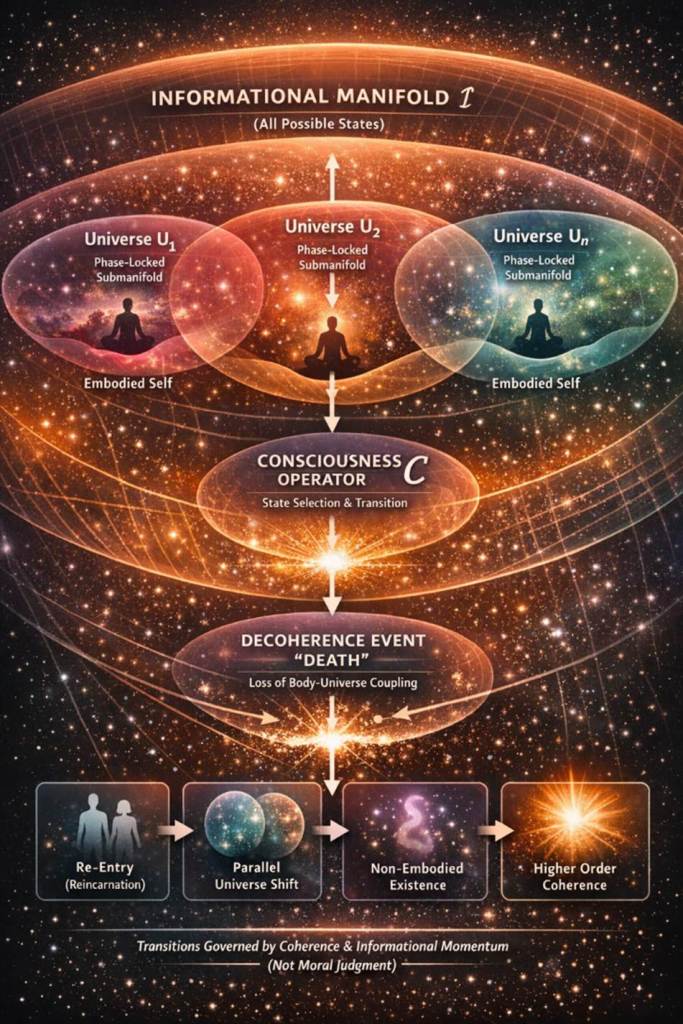







































 BEING AND CREATION BLOG
